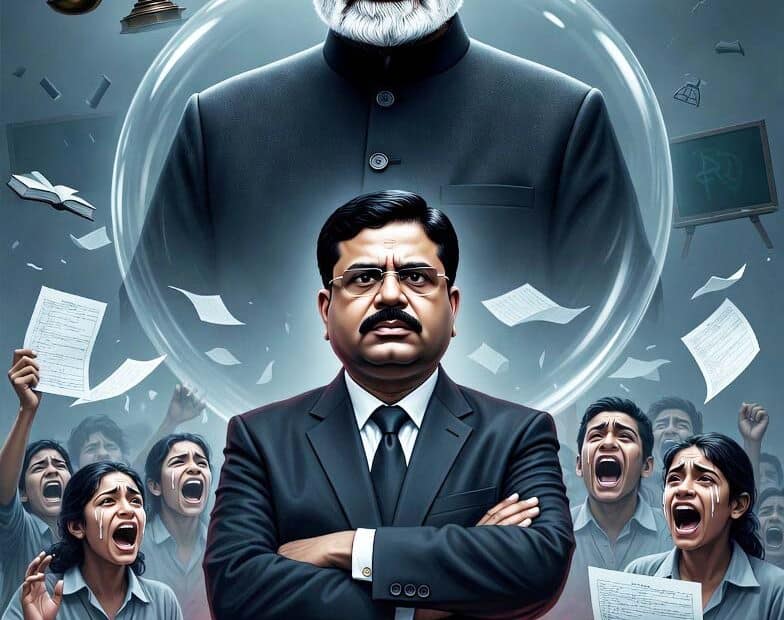
As NTA systemic collapses trigger national outrage, Union Minister Dharmendra Pradhan relies on the PM’s “No-Resignation” doctrine to survive political crossfires.
As New Delhi wakes up to the escalating stand-off at Jantar Mantar—where police recently used a wall of white curtains to forcibly whisk away climate and education activist Sonam Wangchuk on the 21st day of his indefinite hunger strike—the burning question on every citizen’s lips remains unanswered: Why won’t Union Education Minister Dharmendra Pradhan resign?
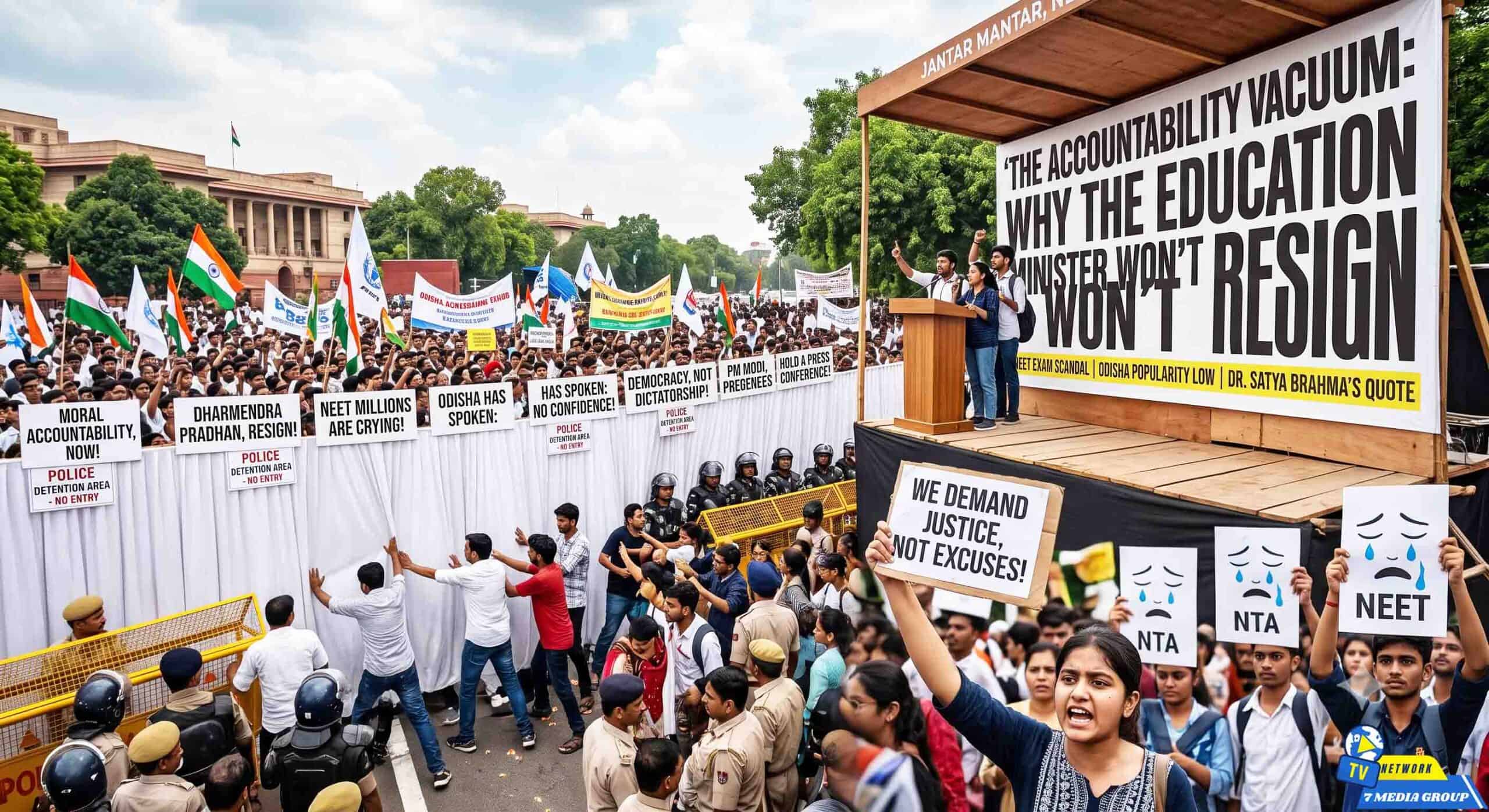
In any mature, self-respecting democracy, a systemic collapse of national entrance examinations like NEET affecting millions of students would trigger an immediate exit of the political executive. Eminent academics, retired professors, and thousands of students have collectively written letters demanding moral accountability. Yet, Pradhan remains firmly entrenched in his chair.
The reason he won’t step down is simple: under the current political architecture of Prime Minister Narendra Modi, resignation is viewed not as an act of integrity, but as an admission of weakness.
The Home-State Disconnect: The Odisha Slide
While Pradhan maintains structural immunity in New Delhi, the political ground beneath his feet is fracturing back home. Long projected as a frontrunner to shape the local narrative, empirical voter data indicates his popularity within his home state of Odisha is on a severe decline.
Data from the highly respected Lokniti-CSDS Post-Poll Survey highlights a critical trust gap:
- The Leadership Deficit: Even among voters who actively cast their ballots for the Bharatiya Janata Party (BJP) at the national level, a staggering three-fifths chose alternative state leadership, while only 17% viewed Pradhan as their preferred choice to lead the state’s destiny.
- The Authenticity Deficit: The survey noted that despite aggressive attempts by the Minister to craft an authentic regional image through local cultural events, the Odia electorate largely viewed his political style as detached from ground realities, leaving him unable to carve out sustainable independent support in the local media discourse.
The Doctrine of No Retreat
Dharmendra Pradhan’s defiance is not an isolated choice; it is a feature of a highly centralized, iron-fisted governance model where public feedback loops and civic protests are routinely disregarded. The Modi administration operates on a doctrine that treats civic agitations not as legitimate democratic expressions, but as law-and-order challenges to be managed, suppressed, or outlasted.
A System Intolerant to Democratic Friction
“The complete refusal to acknowledge institutional breakdown is no longer just bad governance; it is an active assault on the democratic principle of public accountability. When ministers treat mass systemic failures as public relations hurdles rather than moral crises, the bridge of trust between the citizen and the state is completely burnt.”
When the Cockroach Janta Party (CJP) and civil rights groups intensified their agitation, the state’s apparatus chose medical detentions and police clampdowns over transparency. This has forced protest organizers to widen their scope, with movement leaders stating, “We thought the Prime Minister would sack the Education Minister, but instead they attacked students… Narendra Modi does not want to sack Dharmendra Pradhan, so he is also responsible.”
THE ANATOMY OF SYSTEMIC IMMUNITY
├── The Rail Crisis ── Railway leadership retains portfolio despite catastrophic accidents.
├── The State Shield ── Severe allegations of land-grabbing against top regional leadership disappear from mainstream focus.
└── The Exam Crisis ── Dharmendra Pradhan remains untouched despite national systemic failures.
A Pattern of Deflected Accountability
This resistance to structural accountability forms the very bedrock of the ruling dispensation’s political survival strategy:
- The Railway Precedent: Multiple catastrophic train collisions have shaken the nation’s confidence in public safety over recent years. In a previous era, railway ministers resigned out of sheer moral obligation. Today, the portfolio remains undisturbed, setting a precedent that body counts do not dictate political exits.
- The Vanishing Scams: From high-profile land-grabbing allegations involving key regional leaders like former Madhya Pradesh leadership to financial discrepancies, the script remains identical. Once an issue enters the political domain, it is aggressively shielded until it drops out of the media cycle.
- The Policy Monologue: The education sector faces deep structural anxiety, yet the executive refuses to engage in open parliamentary or public debates regarding a fair education policy. Decisions are handed down vertically; criticism is labeled as politically motivated obstructionism.
The Silent Executive
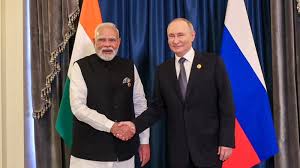
At the apex of this architecture sits a Prime Minister who has transformed the relationship between the executive and the public. While PM Modi frequently visits foreign capitals to project structural stability abroad, he has famously not held a single unscripted, open press conference since assuming office in 2014.
By eliminating the requirement to face direct questioning from an independent press, the government has decoupled governance from immediate public accountability. When the top executive is entirely immune to the traditional scrutiny of the fourth estate, a Union Minister has zero structural incentive to offer a resignation.
Dharmendra Pradhan will not resign because the system he belongs to does not recognize moral responsibility as a currency. In a political landscape where public outrage is treated as noise and institutional failure is defended as a conspiracy, staying in power isn’t just a personal choice—it is an official mandate.
The structural and institutional flaws within the National Testing Agency (NTA) that precipitated the nationwide NEET crisis have been thoroughly scrutinized by a high-level Parliamentary Panel and the government-appointed Dr. K. Radhakrishnan Expert Committee.
Investigations revealed a broken architecture driven by structural vulnerabilities, excessive administrative outsourcing, and a failure to update security protocols for a massive centralized system.
- The “Adhocism” Trap and Heavy Outsourcing
The single greatest operational vulnerability identified was the NTA’s extreme dependence on external resources and third-party vendors for critical operations.
- Vulnerable Logistics: Core, sensitive tasks—including the preparation of question papers, massive printing contracts, and end-mile distribution—were outsourced to private entities rather than handled through a secure internal command chain.
- Casual Staffing: High-stakes logistical operations were heavily managed by temporary or contract-based personnel, creating a lack of long-term institutional accountability and opening doors for “insider breaches” and the proliferation of organized cheating rings.
- Lack of Specialization & Mission Creep
Initially designed to streamline higher education entrance tests, the NTA suffered from severe “mission creep”. The agency took on unrelated recruitment tests, diluting its operational focus. By simultaneously managing complex exams like UGC-NET, CSIR-NET, CUET, and NEET, the limited internal capacity was stretched thin. This lack of focused governance meant that a localized operational breakdown quickly spiraled into a national systemic crisis.
- Compromised Chain of Custody & Testing Infrastructure
The NTA struggled with a single-point failure model.
- The Pen-and-Paper/OMR Vulnerability: Maintaining a physical paper trail for millions of candidates nationwide exposed severe security lapses during physical transit and storage.
- Private Testing Centers: Rather than relying exclusively on highly controlled government institutions (like Kendriya Vidyalayas or Navodaya Vidyalayas), examinations were outsourced to private centers. These facilities frequently lacked standardized CCTV surveillance, stringent proxy-fraud detection, and independent presiding officers—turning them into soft targets for paper leaks and local malpractice.
- Poor Coordination with State Frameworks
Education operates as a concurrent subject in India, but the NTA functioned in an isolated, top-down vertical framework. The expert committee flagged a distinct lack of strong institutional linkages with state and district authorities. By failing to integrate local administration, intelligence, and law enforcement into the primary test security protocol, the NTA was consistently caught flat-footed by organized “paper mafias” operating across state lines.
- Absence of Tech-Driven Guardrails
While modern international exams rely on advanced cybersecurity, the NTA’s digital defense mechanism was badly outdated:
- No End-to-End Encryption: The system lacked end-to-end encrypted digital question paper transmission, meaning physical leaks at the printing or storage levels could not be locked down remotely.
- Opaque Normalization: When errors or disruptions occurred, the NTA relied on opaque normalization metrics and arbitrary grace marks, severely bruising public trust and driving deep student anxiety.
The Restructuring Mandate
Faced with these glaring gaps, the Ministry of Education has committed to transitioning NEET to a Computer-Based Test (CBT) format to eliminate physical paper transit risks. Structurally, the Radhakrishnan Committee has demanded an end to “adhocism” by creating a permanent in-house data security vertical, introducing independent audit boards, and strictly reducing reliance on private private third-party entities.
The convention of an Indian Union Minister resigning on “moral grounds” is rooted in the early decades of India’s post-independence democracy. Over the last two decades, however, this convention has undergone a complete systemic transformation, shifting from an era of individual moral accountability to one of institutional collectivization and political containment.
The Historical Precedents (1950s–1990s)
In the initial decades after 1947, ministerial resignations were treated as essential tools of constitutional propriety, signaling that the political executive accepted ultimate responsibility for the failures of their departments, even without personal complicity.
- The Gold Standard (Lal Bahadur Shastri, 1956): The most celebrated historical precedent occurred when Lal Bahadur Shastri resigned as Railway Minister. Following a catastrophic train accident in Mahabubnagar in August 1956, he tendered his resignation, which Prime Minister Jawaharlal Nehru refused. However, when another major train disaster occurred in Ariyalur just three months later, killing over 140 people, Shastri insisted on stepping down to do “penance”. Nehru accepted the resignation explicitly to set an example of high constitutional standards, noting that Shastri bore no personal blame for the technical failure.
- The Anti-Corruption Standard (TT Krishnamachari, 1958): Union Finance Minister TT Krishnamachari resigned after the Chagla Commission—which held public hearings regarding a financial scandal involving the Life Insurance Corporation (LIC)—found administrative lapses within his ministry. Even though the commission did not find personal corruption on his part, he stepped down to honor public trust.
- The Strategic Retreats (Nitish Kumar, 1999): Even into the late 1990s, the tradition persisted. Railway Minister Nitish Kumar resigned immediately following the Gaisal train disaster in Assam, which claimed nearly 290 lives, taking direct moral responsibility.
How the Convention Has Changed Over the Last Two Decades
The structural framework governing political accountability has dramatically evolved. The traditional concept of individual moral responsibility has largely been replaced by a “doctrine of no retreat.”
The core shifts driving this transformation include:
- From “Individual Error” to “Conspiracy and Sabotage”
Historically, a major disaster or systemic leak was viewed as a failure of administrative oversight, compelling the minister to own the mistake. In contemporary politics, major lapses are swiftly reframed by the ruling executive as deep-seated conspiracies, bureaucratic sabotage, or politically motivated attacks by opposition forces. Because the crisis is characterized as an external assault rather than an internal failure, a resignation is actively discouraged, as it would signal a capitulation to adversaries.
- The Rise of the “No-Resignation” Executive Doctrine
Under the current highly centralized political landscape, the executive architecture views a ministerial resignation not as a tool of integrity, but as an admission of weakness that grants the opposition political leverage. Rather than dismissing a minister under public pressure, the executive modern strategy relies on outlasting the media cycle. If a portfolio change is deemed necessary, it is executed quietly during a subsequent periodic cabinet reshuffle rather than as an immediate accountability measure (e.g., Suresh Prabhu’s transition out of the Railway Ministry in 2017 following a string of accidents).
- Institutionalizing the Blame (Bureaucratic Sacrificial Lambs)
The responsibility for systemic failures has shifted downward from the political head to autonomous bodies and top bureaucrats. When massive crises occur—such as the national entrance exam leaks or infrastructure failures—the government establishes high-level probe committees (like the Radhakrishnan Committee for the NTA) and suspends or replaces agency directors and technical chiefs. By penalizing the operational heads, the political executive creates a firewall that insulates the Union Minister from needing to step down.
- The Separation of Public Outrage from Electoral Outcomes
The ultimate deterrent that once compelled historical ministers to resign was the fear of severe electoral blowback for the ruling party. Today, dominant political parties rely on centralized leadership, sweeping ideological narratives, and robust welfare delivery models to win elections. Because individual ministerial performance rarely shifts the broader electoral tide, ministers are no longer bound by the traditional pressures of local popularity or direct accountability to the electorate.
Author

Satya Brahma’s Vision India
Photo Gallery