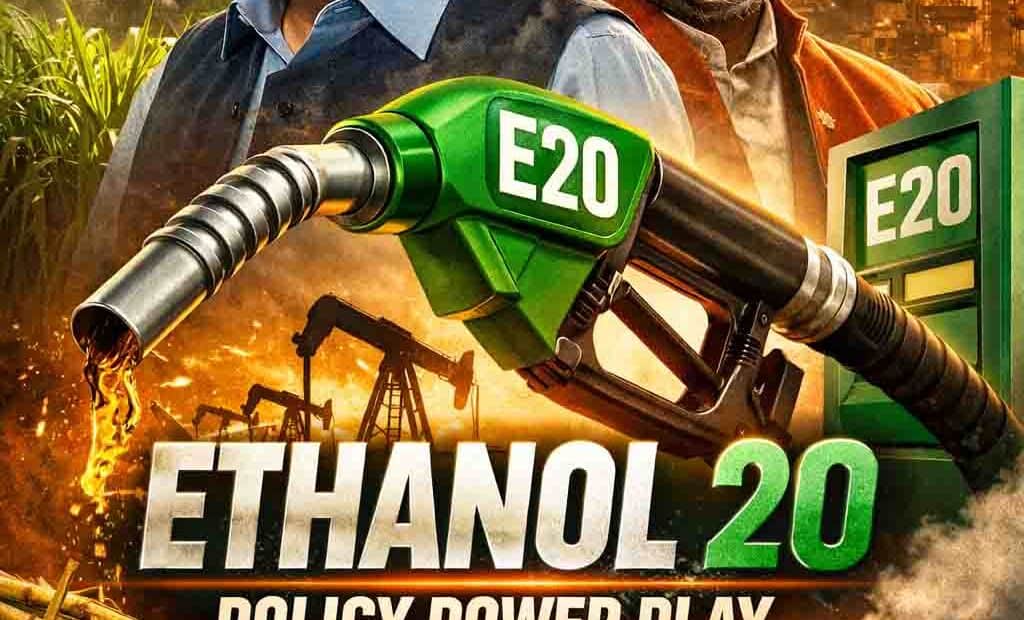
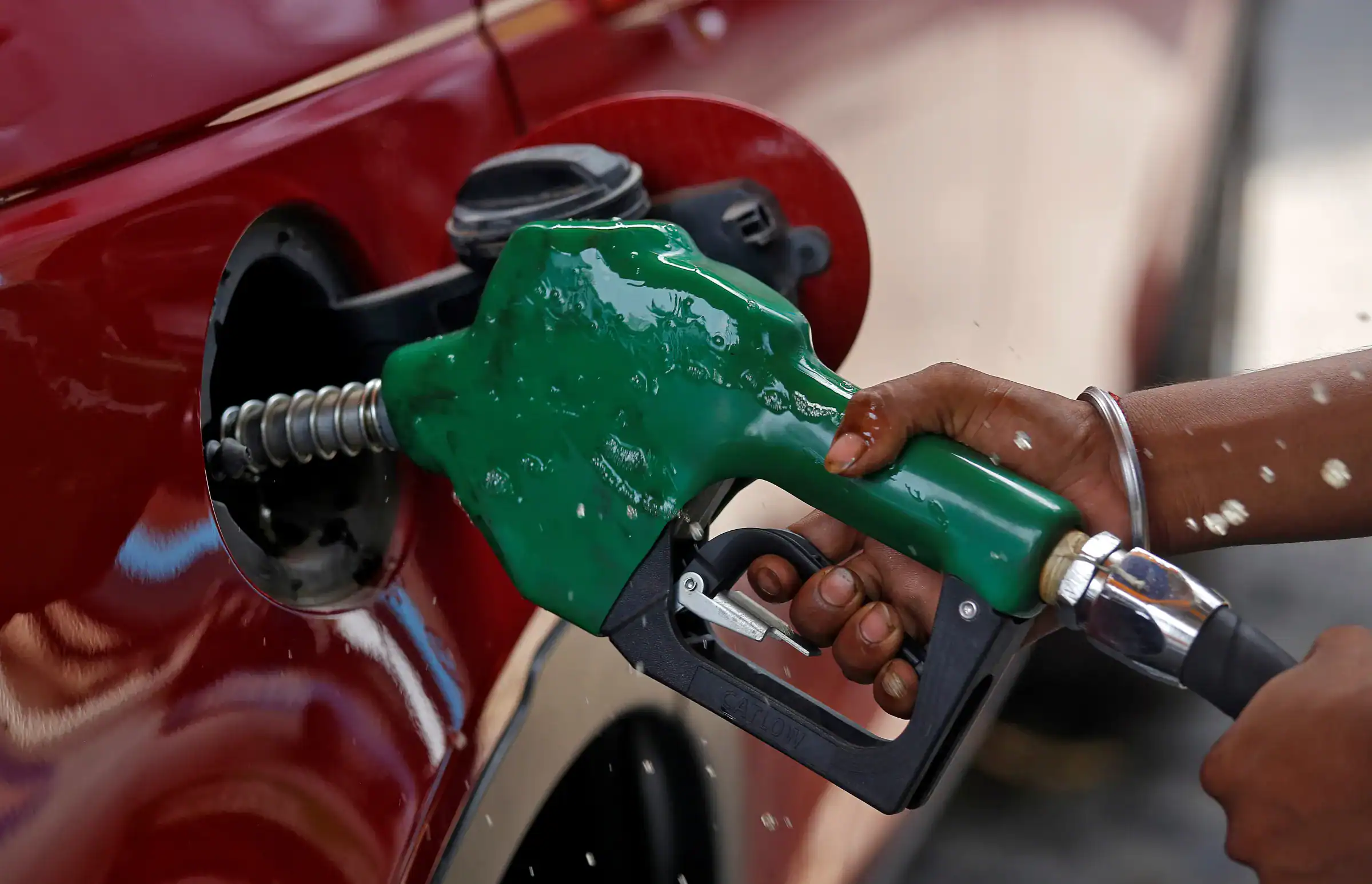
India’s aggressive, hyper-accelerated transition to green fuel has breached its final checkpoint. The mandatory nationwide rollout of E20 petrol (20% ethanol, 80% fossil fuel) has moved from a policy roadmap into the fuel tanks of millions of citizens. But beneath the state-sponsored narrative of ecological rescue and rural empowerment lies a bitter struggle involving consumer anxiety, corporate compliance, and intense political scrutiny.
As motorists report dropping fuel mileage and express fears over long-term engine degradation, Network 7 Media Group examines the economic architecture, international benchmarks, and political maneuvers driving India’s forced energy pivot.”The true measure of any state policy is not the nobility of its stated intent, but where the financial gravity ultimately lands. If the citizen pays the price at the pump while the state guarantees the margins of a select corporate few, it ceases to be an energy transition—it becomes an economic transfer masked as an ecological crusade.” says — Dr. Satya Brahma, Editor-in-Chief, Network 7 Media Group
The Executive Architect: Protecting the Capital Loop
Public scrutiny has consistently focused on the intense executive momentum generated by Union Road Transport Minister Nitin Gadkari and Petroleum Minister Hardeep Singh Puri. Critics point to the policy’s structural bias toward the highly organized sugar cooperative lobby and massive private agro-distilleries—traditional centers of political influence in Maharashtra, Uttar Pradesh, and Bihar.
Addressing allegations of direct conflict of interest, Minister Gadkari went on record to dismantle claims regarding personal financial gain:
“I gain nothing from the ethanol policy. My family’s share in ethanol production is just 0.07 per cent. With such a small stake, there is no question of any significant financial benefit.”
Instead of personal enrichment, the actual institutional drivers managed by Gadkari and Puri point toward a broader macroeconomic calculus. The state’s aggressive strategy anchors itself on two distinct financial imperatives:
-
Import Substitution: Shaving down India’s massive ₹22 lakh crore annual crude oil import bill.
-
Banking System Protection: Insulating roughly ₹1 lakh crore in institutional bank loans extended to private entrepreneurs and cooperatives for setting up dedicated ethanol manufacturing plants.
The policy effectively functions as a massive sovereign underwriting project, transforming agricultural waste and surplus grains into a state-mandated asset class.
The Premier’s Silence: De-linking Political Capital from the Pump
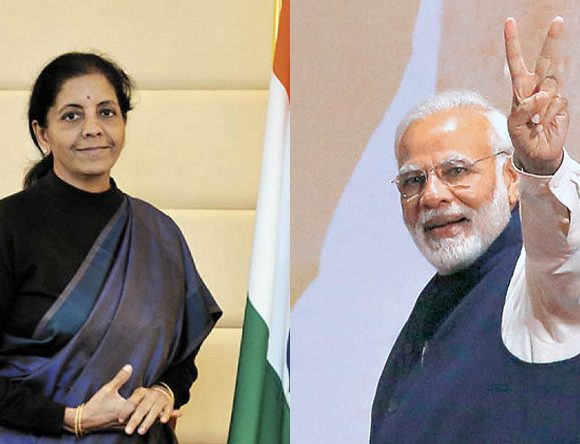
A persistent question among consumer advocacy groups is why Prime Minister Narendra Modi has remained silent regarding localized grievances—specifically the drop in consumer fuel efficiency and the long-term risk of engine corrosion.
The silence is tactical. Rather than involving the Prime Minister’s Office in the micro-level mechanics of fuel chemistry or technical vehicular faults, the political apparatus has framed the ethanol mandate purely as a high-altitude geopolitical victory. It is messaged through the lens of Atmanirbhar Bharat (self-reliant India), global decarbonization pledges, and national security via energy decoupling.
By maintaining this rhetorical distance, the top tier of governance insulates its political capital from consumer pushback, delegating the operational friction and public anger entirely to the respective ministries and auto manufacturers.
The Auto Lobby: Why the Manufacturing Giants Chose Silence over Dissent
Many expected major automobile manufacturers to fiercely resist a mandatory fuel blend that drops real-world fuel economy by 3% to 5% due to ethanol’s lower energy density. Yet, the Society of Indian Automobile Manufacturers (SIAM) and market leaders like Maruti Suzuki and Tata Motors have actively aligned with the state narrative.
This compliance is the result of regulatory pragmatism and early intervention:
-
Prolonged Structural Lead-Time: The central government integrated the auto industry into the NITI Aayog ethanol roadmap as early as 2021. Manufacturers were given years to re-engineer fuel injectors, rubber gaskets, and catalytic converters to handle the corrosive properties of high-blend alcohol.
-
Aggressive Data Offensives: In defensive statements, industry leader Maruti Suzuki noted that out of 2.84 crore vehicles serviced in their network, over 1.5 crore were older, non-E20 certified models. Their internal field metrics showed no systemic, chemically induced engine failures, attributing sporadic breakdowns instead to water contamination at local fuel stations rather than ethanol corrosion.
-
Logistical Monopolies: The Indian state operates a centralized, rigid fuel distribution network of over one lakh retail outlets. The government made it clear that it would not support duplicate pipelines or multiple storage tanks for pure petrol alongside E10 and E20 due to prohibitive infrastructure costs. Faced with a single, mandatory fuel stream, automakers had to either adapt their engineering or exit the market.
The Global Blueprint: A Compressed Velocity
India’s energy roadmap is structurally modeled on international precedents, but executed at a speed that breaks global norms.
[Global Blend Architectures]
├── Brazil ───────── Mandated E27 standard; widespread Flex-Fuel (E100) infrastructure.
├── United States ── Standardized E10 nationwide; extensive regional E15 / E85 choices.
└── India ────────── Accelerated from ~1.5% (2014) to mandatory E20 nationwide (2026).
Brazil took over four decades to construct its vast, highly sophisticated sugarcane-to-fuel matrix. The United States relies on a heavily subsidized corn infrastructure but offers ethanol blends primarily as a consumer-selected, lower-cost alternative at the pump.
India’s distinct variance is the absolute elimination of consumer choice. The transition was compressed into less than a decade, transforming E20 from an experimental alternative into the inescapable national baseline fuel.
The reality of India’s ethanol push escapes simplistic labeling. It is neither a flawless green revolution nor a hidden political scam. It is an aggressive, calculated exercise in state-directed capitalism.
While Ministers Gadkari and Puri operate within cleared boundaries of direct personal enrichment, the framework they have constructed undeniably secures the financial health of large-scale agro-processors and de-risks billions in public banking sector loans. The ultimate cost of this macroeconomic shift—delivered via reduced fuel mileage and accelerated vehicle aging—is quietly transferred to the everyday Indian motorist, with the quiet concurrence of an automotive industry that chose strategic adaptation over open confrontation.
Author

Related Posts
Satya Brahma’s Vision India
Photo Gallery