
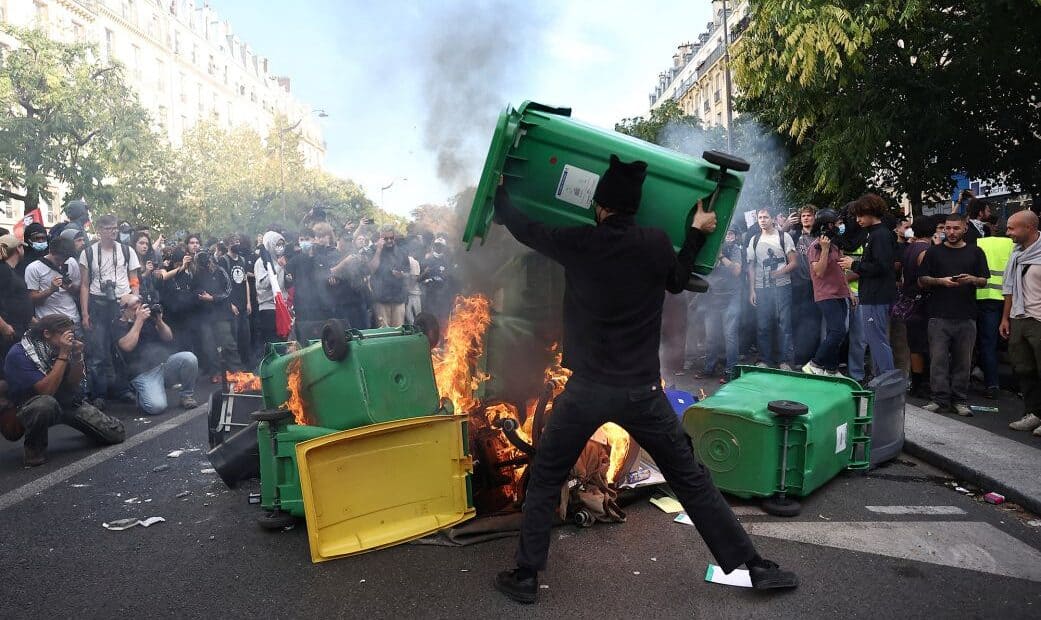
From classrooms to burning streets, France’s unrest exposes a deeper breakdown of trust in political leadership, economic fairness and the promise of social mobility. The consequences could reverberate across Europe and the global economy.
France, the birthplace of the modern republican ideal of liberty, equality and fraternity, is confronting a question that extends far beyond the damage inflicted on its streets: what happens when citizens begin to lose faith in the institutions that claim to represent them?
The violent unrest that swept across France over the weekend of October 17–18 has exposed a country under extraordinary social and political strain. Demonstrations initially driven by students demanding better schools and adequate teaching resources broadened into a nationwide expression of anger over the rising cost of living, declining public services, inequality and a political system increasingly perceived as incapable of delivering meaningful change.
According to reporting by Reuters and Al Jazeera, hundreds of thousands of people participated in demonstrations on October 17. While many protested peacefully, violent groups attacked public buildings, looted businesses and clashed with police. The unrest has intensified pressure on President Emmanuel Macron and his government at a particularly vulnerable moment, with France approaching the 2027 presidential election.
The central question is no longer simply why people are protesting. It is whether France’s political leadership can restore public confidence before social discontent hardens into a prolonged crisis of governability.
Global Ramifications
France is not a peripheral state. It is a founding member of the European Union, a nuclear power, a permanent member of the UN Security Council, and a major economy whose stability underpins the eurozone. Prolonged unrest carries several risks:
- Political contagion: Solidarity protests have already appeared in Italy, Belgium, Portugal and Albania. A sustained French crisis could embolden similar cost-of-living and anti-austerity movements across a Europe still wrestling with debt, energy costs and demographic pressures.
- Market and fiscal pressure: French assets have underperformed; the spread on French government bonds over German benchmarks has widened. Any perception that Paris cannot restore order or pass a credible budget risks higher borrowing costs for France and renewed questions about eurozone fiscal rules.
- Electoral shockwaves: A victory for the far right or a chaotic left-right polarization in 2027 would alter France’s stance on migration, EU integration, energy policy and relations with the United States and China. That, in turn, would reshape the continent’s political center of gravity.
- Soft-power erosion: Scenes of burning public buildings and mass arrests damage France’s image as a stable democracy and complicate its ability to project influence in Africa, the Middle East and multilateral forums.
France’s unrest is neither inexplicable nor purely spontaneous. It is the predictable result of chronic underinvestment in public goods, an over-reliance on debt to paper over structural weaknesses, and a political class that has repeatedly underestimated popular anger. Whether the current wave forces genuine reform, further repression, or simply accelerates the fragmentation of the political center will shape not only France’s trajectory but the stability of Europe itself. The streets have spoken. The question is whether the institutions still listening have the capacity—or the will—to answer.
France is not facing a single-issue protest. It is confronting the convergence of economic insecurity, deteriorating confidence in public institutions and a widening struggle over the country’s political future.
1. The cost-of-living crisis: the economic pressure beneath the anger
For ordinary French households, economic security is becoming an increasingly urgent concern. Housing, transport, energy, food and other essential expenses compete with wages and household budgets, leaving many people feeling that economic progress is not translating into a better standard of living.
The present unrest has been fuelled in part by rising fuel costs and broader anxiety over purchasing power. Public-sector workers and trade unions have also challenged budget proposals that they fear will squeeze wages and public services.
This is where the political crisis becomes especially dangerous.
People may tolerate economic difficulty when they believe it is temporary, fairly distributed and accompanied by credible leadership. They are less likely to accept it when they perceive that ordinary workers, students and lower-income households must absorb the costs while political institutions appear insulated from everyday hardship.
France’s long-standing social model has helped define its national identity. Citizens expect public institutions to provide meaningful protection, accessible education, healthcare and social security. When those expectations collide with fiscal constraints, the resulting disappointment can become politically explosive.
The government, meanwhile, faces a difficult financial reality. France must address public debt and its budget deficit while maintaining services and responding to demands for greater economic protection. The government’s proposed 2027 budget has become part of that confrontation.
The danger is that a debate over public spending becomes a broader argument over who bears the burden of economic adjustment—and whether the sacrifices demanded of citizens are justified by the results.
2. A public education system under pressure—and a generation losing patience
The immediate spark for the latest mobilisation came from the education system.
Students have protested over teacher shortages, inadequate school facilities, long school days and concerns about the fairness and transparency of university admissions. Teachers and families have also voiced frustration over the resources available to schools.
These are not merely administrative complaints. Education represents the promise that a young person can improve their circumstances through talent, effort and opportunity.
When classrooms lack sufficient teachers and students feel that their prospects are narrowing, the promise of social mobility becomes less credible. The frustration can spread well beyond school gates, particularly when young people see housing becoming less affordable and stable employment harder to secure.
The political significance of the protests lies in their expansion beyond students. Trade unions, public-sector employees and people associated with earlier cost-of-living movements have joined the wider mobilisation, connecting education grievances with questions of inequality, public investment and economic justice.
The government’s response reportedly includes commitments to deploy additional substitute teachers and abandon planned increases in certain university registration fees. Such measures may ease immediate pressure, but they cannot by themselves resolve the deeper question of whether public institutions have the resources and political support necessary to fulfil their responsibilities.
A government that treats young people’s grievances solely as a law-and-order problem risks overlooking the social conditions that made the demonstrations possible.
Equally, protest movements lose legitimacy when peaceful demonstrations are used as cover for arson, looting or attacks on public servants. Both realities must be confronted without conflating peaceful protesters with those responsible for criminal violence.
3. Macron’s political dilemma: authority without sufficient political capital
President Emmanuel Macron enters this crisis with his political authority under pressure and his presidency approaching its constitutional end in 2027.
His decision to dissolve the National Assembly in 2024 produced a fragmented parliament rather than a stable governing majority. The resulting political landscape has made it harder to secure durable agreements on budgets and other contentious reforms.
The consequences are now visible in the streets.
A government facing widespread public anger requires more than police deployments and presidential addresses. It needs the parliamentary strength to pass workable policies, the fiscal capacity to finance credible concessions and the political legitimacy to persuade citizens that the burden of adjustment is being shared fairly.
Macron faces constraints on all three fronts.
Reuters reported on October 19 that former allies have openly criticised his handling of the political situation, while opposition figures are seeking to capitalise on the unrest ahead of the presidential election.
This is the central paradox of the crisis: the state is under pressure to demonstrate authority, yet its capacity to make concessions is constrained by public finances and political fragmentation.
A purely coercive response may restore order temporarily. It cannot, on its own, restore confidence.
Conversely, concessions announced without a credible funding plan may intensify concerns about fiscal sustainability. Macron’s challenge is to demonstrate that public order, economic responsibility and social fairness are not mutually exclusive objectives.
4. Why the streets matter: the warning of the Yellow Vest movement
France has experienced major waves of protest before. The Yellow Vest movement, which erupted in 2018, demonstrated how a seemingly specific economic grievance could become a much broader revolt against perceived inequality, political distance and the concentration of decision-making power.
The present crisis carries echoes of that experience, although the immediate triggers and the political circumstances are different.
The lesson is that social unrest rarely remains confined to its original demand when citizens believe their grievances share a common cause.
A dispute over school staffing can become a protest against public spending priorities. Rising fuel prices can become a debate over the distribution of economic pain. Frustration with a budget can become a challenge to the legitimacy of the government itself.
The most consequential development is therefore not simply the scale of any individual demonstration. It is the convergence of groups whose demands may differ but whose distrust of the political establishment increasingly overlaps.
This does not mean France’s protesters constitute a unified political movement or share a common programme. It means that separate grievances can reinforce one another when the public perceives a broader failure of representation.
The government must recognise that distinction if it is to prevent a series of protests from becoming a sustained crisis of legitimacy.
5. Violence, policing and the battle over the meaning of protest
The destruction of public property, attacks on police and emergency personnel, arson and looting are serious offences. They threaten public safety, damage livelihoods and can undermine the democratic legitimacy of a movement.
Businesses forced to close, workers prevented from earning wages and residents caught in violent confrontations pay a price for the breakdown of public order. The state has a responsibility to protect them and enforce the law.
But the opposite danger must also be recognised: treating an entire protest movement as violent because some participants commit crimes.
Reports on the October unrest describe a large mobilisation in which peaceful demonstrations coexisted with serious violence by a minority. The distinction matters. Collective punishment, indiscriminate policing or the dismissal of legitimate grievances could deepen the distrust that authorities are attempting to overcome.
France now faces a dual test: whether it can restore public order while protecting the right to peaceful dissent, and whether it can distinguish legitimate political opposition from criminal conduct.
A democracy’s strength is not measured solely by its ability to disperse a crowd. It is also measured by its ability to hear grievances, apply the law impartially and correct failures without surrendering to violence.
6. The political beneficiaries: a crisis that could reshape the 2027 election
Political instability rarely leaves an electoral vacuum.
With Macron unable to seek a third consecutive presidential term, the struggle to define France’s next political chapter is already intensifying. The unrest gives opposition parties an opportunity to argue that the existing political centre has failed.
The far-right National Rally, associated with Marine Le Pen and Jordan Bardella, may benefit from public concerns about order, immigration, national identity and the perceived inability of established parties to govern effectively. The left, including Jean-Luc Mélenchon’s France Unbowed movement, can mobilise opposition to austerity, inequality and what it describes as an unjust distribution of economic burdens. Other conservative and centrist figures will also seek to position themselves as credible alternatives.
These competing forces do not offer the same diagnosis or remedies. Their common opportunity is that a weakened government makes the demand for political change more compelling.
The danger for France is that the presidential campaign becomes a contest of polarising promises rather than a serious debate about how to reconcile public services, fiscal sustainability, economic growth and social cohesion.
The outcome remains uncertain. Unrest does not automatically translate into votes for one party, and the electorate is not politically uniform. But if the crisis persists, it could strengthen candidates who promise a decisive break with the existing order.
The question facing France is not only who will occupy the Élysée Palace after 2027. It is whether the next president will inherit a country capable of reaching broad political compromises—or one in which every major reform risks triggering another confrontation.
7. The economic danger: when street unrest meets financial-market anxiety
France is one of Europe’s largest economies and a central member of the eurozone. Prolonged instability would therefore have consequences beyond its national borders.
Investors assess political risk partly through the government’s ability to pass budgets, maintain fiscal credibility and sustain predictable economic policy. When street violence coincides with parliamentary paralysis and uncertainty over public finances, concerns can reinforce one another.
Axios reported on October 19 that the unrest had coincided with renewed volatility in France’s bond market, highlighting the risk of a feedback loop between fiscal pressures, political instability and market confidence.
The mechanism is straightforward, although the eventual scale of any impact remains uncertain.
- Political uncertainty can raise the risk premium investors demand to hold government debt.
- Higher borrowing costs can increase the expense of financing public services and refinancing existing obligations.
- Tighter fiscal constraints can make it harder for the government to respond to social demands.
- Further spending disputes and public anger can, in turn, deepen political uncertainty.
This is not an inevitable chain, nor does a short period of unrest necessarily produce a lasting financial crisis. But a prolonged loss of confidence could make France’s fiscal choices more difficult and complicate economic policy across the eurozone.
Businesses may postpone investment, households may become more cautious and tourism or retail activity may suffer in affected areas. The consequences would depend on the duration, geographical spread and intensity of the unrest.
France’s economic importance means that markets will be watching not only the immediate security response but also whether its political institutions can produce a credible and durable budget settlement.
8. The European Union: instability at the heart of the bloc
France’s predicament matters because the European Union depends on cooperation among its largest member states to address economic competitiveness, defence, energy security, migration and relations with major powers.
A French government consumed by domestic unrest may have less political room to pursue ambitious European initiatives. A fragmented parliament can complicate commitments that require sustained budgets, cross-party support or difficult domestic reforms.
The impact could be particularly significant in three areas.
European defence and strategic autonomy: France has long advocated a stronger European capacity to defend its interests. Prolonged domestic instability could make it harder to sustain political consensus around defence spending and long-term strategic initiatives.
Economic and fiscal policy: France’s budget position is central to debates about the eurozone’s fiscal rules and the balance between investment and restraint. A deeper French fiscal crisis could intensify disagreements over how Europe should manage debt, growth and public expenditure.
Political cohesion: If economic insecurity and distrust of established parties continue to strengthen polarising movements, European governments may find it harder to build common positions on migration, trade, climate policy and support for Ukraine.
France is not the only European country facing these pressures. The latest reporting points to related protests over living costs, education and housing in other parts of Europe. The French crisis should therefore be understood both as a national emergency and as a warning about wider social and political strains across the continent.
9. What does France’s unrest mean for the rest of the world?
The international consequences would depend on whether France moves towards stabilisation or prolonged political confrontation. Four areas deserve particular attention.
First: the euro and global financial markets.
Sustained uncertainty surrounding a major eurozone economy could affect investor sentiment towards European assets, influence borrowing costs and increase volatility in currency and bond markets. The impact would depend on fiscal developments, the European Central Bank’s policy environment and whether investors view the turmoil as temporary or structural.
Second: global trade and investment.
France is a major market and an important participant in European manufacturing, aerospace, luxury goods, energy, agriculture and services. A prolonged domestic crisis could disrupt local business activity and weaken investment confidence. The wider impact would be greater if instability affected European demand or complicated cross-border economic policy.
Third: international diplomacy and security.
France is a permanent member of the United Nations Security Council and an important European defence power. Domestic political paralysis could reduce the government’s capacity to build coalitions and sustain diplomatic initiatives. However, France’s international commitments and institutions would not automatically cease functioning because of street unrest.
Fourth: the global debate over democracy and economic fairness.
France’s crisis may resonate in countries where citizens feel that economic growth, technological change and national prosperity have failed to deliver security or opportunity for ordinary people.
The lesson is not that every democracy is destined for French-style unrest. Political systems differ, and national circumstances cannot be treated as interchangeable. Rather, France illustrates a broader risk: when people lose confidence that established institutions can respond to everyday economic and social pressures, political dissatisfaction can spread beyond individual policies to the legitimacy of the system itself.
For governments across the world, this is a warning against confusing macroeconomic indicators with lived economic reality. Growth figures matter, but so do affordable housing, credible public services, employment prospects and the public’s belief that institutions are responsive and accountable.
10. What happens next? Three possible scenarios
France’s trajectory will depend on the government’s ability to contain violence, engage legitimate protesters and reach a workable political and fiscal settlement.
Scenario one: stabilisation through negotiation. Authorities restore public order while delivering credible improvements in education, protecting essential services and engaging unions, students and parliamentary opponents. The crisis gradually subsides, although political divisions remain.
Scenario two: recurring unrest and prolonged paralysis. Immediate concessions prove insufficient, demonstrations return, and successive budget and policy disputes weaken the government further. Business confidence suffers and the 2027 presidential campaign becomes increasingly confrontational.
Scenario three: deeper political and financial instability. Renewed violence combines with a breakdown in budget negotiations and a sustained deterioration in market confidence. The government faces greater difficulty financing commitments and maintaining a stable policy direction, creating a more serious challenge for France and its European partners.
These are analytical possibilities, not predictions. None is inevitable, and the direction of events will depend on decisions made by the government, political parties, protest organisers, law-enforcement authorities and wider civil society.
France’s unrest cannot be explained away as the work of troublemakers, nor can the destruction and violence be excused as an acceptable expression of public anger.
Both simplistic narratives fail to confront the underlying challenge.
The French state must protect citizens, prosecute criminal conduct and restore public order. At the same time, political leaders must confront the conditions that have brought students, workers and other disaffected groups into the streets: anxiety over living standards, concerns about deteriorating public services, frustration with political paralysis and uncertainty about the future.
A durable response requires more than a security operation. It requires a credible social and economic settlement—one that recognises fiscal constraints without treating them as an excuse to disregard legitimate public concerns.
Macron’s remaining months in office will be judged not simply by whether the streets become quiet, but by whether France emerges with a clearer path towards political stability. His successor will inherit the consequences of decisions made now, as well as a society whose competing expectations will not disappear with a change of president.
For Europe, the stakes are considerable. For the global economy, the warning is equally clear: political stability cannot be taken for granted when economic insecurity and institutional distrust reinforce one another.
France has not abandoned its democratic foundations. Its institutions continue to operate, its citizens continue to debate their future, and the outcome remains open. But the country is facing a serious test of its capacity to reconcile authority with accountability and economic responsibility with social fairness.
The ultimate question is whether France’s leaders can rebuild public trust before anger on the streets becomes a lasting crisis of confidence in the state itself.
Editorial note: This is an independent analytical feature based on reporting available as of October 19, 2026. It distinguishes reported developments from analysis and potential future scenarios. Allegations about individual actors, the precise causes of particular violent incidents and claims of political orchestration should be established through independently verified evidence before publication as fact.
Author

Related Posts

Satya Brahma’s Vision India

Photo Gallery