
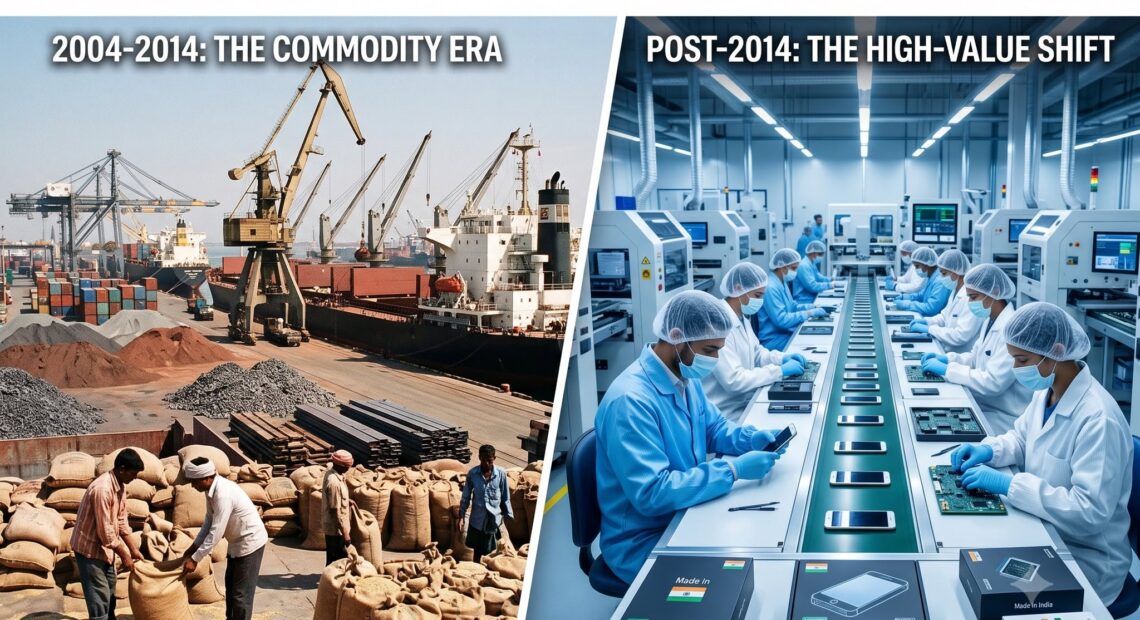
An independent analysis of India’s export story reveals two distinct eras of growth driven by entirely different engines. The real story isn’t just a political scorecard of who achieved a higher percentage—it is a tale of shifting global economic tides and a fundamental transformation in what India actually sells to the world.
During the UPA years (2004–2014), India’s export growth was blistering, primarily lifted by a massive boom in global trade and commodity prices. Under the NDA (2014–present), percentage growth slowed due to global economic stagnation, trade wars, and the pandemic, but the absolute value of exports hit historic highs, driven by a structural shift toward high-value manufacturing and services.
By the Numbers: UPA vs. NDA
While both administrations oversaw significant expansion, they did so under vastly different global conditions.
| Metric | UPA Era (Ending 2013-14) | NDA Era (2023-24) |
| Total Overall Exports | ~$466 Billion | ~$778.2 Billion (Crossed $820B in FY 24-25) |
| Services Exports | ~$152 Billion | ~$341.1 Billion (Approaching $383B) |
| Engineering Goods | ~$62.2 Billion | ~$109.3 Billion |
| Mobile Phone Exports | ~$0.2 Billion | ~$15.6 Billion |
| Global Trade Context | Booming (~50% global trade growth 2009-2014) | Stagnant/Volatile (~3.7% global trade growth 2014-2018) |
The UPA Era: Riding the Global Wave
The UPA government oversaw a golden period for emerging markets. From 2004 to 2014, global demand was voracious, and commodity prices were high. India’s exports mirrored this global boom, growing by over 126% during UPA-2 alone. However, the export basket was still heavily reliant on traditional sectors like textiles, gems and jewellery, and raw materials, making it highly sensitive to global commodity cycles.
The NDA Era: Navigating Headwinds and Structural Shifts
When the NDA took power in 2014, the global commodity super-cycle had crashed, and world trade growth was flatlining. Consequently, India’s export growth in the early NDA years was sluggish—hovering around 10% in the first five years. However, post-COVID, the NDA administration leveraged geopolitical shifts (“China Plus One”) and implemented Production Linked Incentive (PLI) schemes.
This resulted in the real success story of the NDA era: Compositional transformation.
The Structural Transformation
The true contrast between the two eras lies in the changing DNA of India’s export basket:
-
The Electronics Boom: In 2014, India exported a negligible $200 million in mobile phones. By 2023-24, driven by major players like Apple shifting assembly to India, mobile phone exports skyrocketed to $15.6 billion. Electronic goods are now among India’s top five exports.
-
Engineering and Pharmaceuticals: Moving away from raw materials, India has established itself as a hub for complex manufacturing. Engineering goods surged to over $109 billion, and pharmaceutical exports nearly doubled from $15 billion (2013-14) to $27.8 billion (2023-24).
-
The Services Juggernaut: While the IT boom began well before 2014, it evolved under the NDA from basic call centers to Global Capability Centers (GCCs), R&D, and high-end financial services, pushing services exports past the $340 billion mark.
The UPA era wins on pure percentage growth, heavily aided by a booming global economy. The NDA era wins on absolute scale, resilience against global stagnation, and successfully upgrading India’s export machinery from traditional goods to high-tech manufacturing and premium services.
While the UPA era rode a massive global commodity wave to deliver record percentage growth, the NDA administration engineered a structural pivot—transforming India into a resilient powerhouse of electronics, pharmaceuticals, and high-value services amidst severe global headwinds.
“The true measure of India’s export journey isn’t found in a political scoreboard of percentage points, but in the structural metamorphosis of our economy. We have evolved from merely exporting raw materials during a global boom to commanding a decisive seat at the high-tech manufacturing table. The real victory is no longer just about how much India sells to the world, but what India is now capable of creating.” — Dr. Satya Brahma
The geopolitical factors driving this shift
The “China Plus One” strategy—a global corporate mandate to diversify manufacturing away from China—acted as the ultimate catalyst for India’s recent export boom. While the trade wars of 2018 planted the seeds, it was the supply chain shocks of the COVID-19 pandemic that forced multinational companies to urgently seek a “Plus One.”
India captured this exact moment by pairing its massive demographic advantage with aggressive policy incentives, fundamentally rewiring its export capability over the last five years.
Author

Related Posts


Satya Brahma’s Vision India

Photo Gallery