New Delhi’s 2026 summit advanced sectoral cooperation, secured a rare collective condemnation of terrorism, and kept the expanded grouping focused on Global South priorities—without forging a formal anti-Western bloc or resolving deeper India-China or India-Russia differences
New Delhi, September 2026 — Under India’s chairmanship of the expanded BRICS grouping, the 18th Leaders’ Summit in New Delhi concluded with the unanimous adoption of the New Delhi Declaration, a 140-paragraph document that navigated sharp geopolitical divides while producing concrete institutional and economic outcomes.
Prime Minister Narendra Modi’s government framed the year-long chairship around the theme “Building for Resilience, Innovation, Cooperation and Sustainability.” Officials and independent assessments describe the result as a diplomatic success in process and agenda-setting, rather than a transformative geopolitical realignment.
What India Achieved
India hosted more than 350 meetings and high-level engagements across multiple cities during its presidency, culminating in the two-day leaders’ summit on 12–13 September. The New Delhi Declaration was adopted without formal objection despite the presence of members with conflicting positions on conflicts in West Asia and Ukraine.
Key deliverables included:
– New sectoral mechanisms: Centres of Excellence on Agro-Ecology (initially coordinated by an ICAR institute), a Network on Digital Agriculture (IIT Delhi), and AGRIN (Agro-Inputs, Genetic Resources and Information Network).
– Health initiatives: A BRICS Mission for Healthy Lifestyle with a 2026–29 roadmap, and a Network of Centres of Excellence on Mental Wellness coordinated by NIMHANS.
– Economic and practical frameworks: A voluntary BRICS Logistics Supply-Chain Cooperation Framework, progress on the BRICS Economic Partnership 2030, greater emphasis on local-currency settlement and trade finance, and a target for the New Development Bank to raise local-currency lending.
– Digital and technology focus: Showcasing of India’s Digital Public Infrastructure (UPI, Aadhaar, ONDC) and commitments on AI governance, cybersecurity, and standards cooperation.
India also secured explicit language in the declaration condemning “in the strongest terms” the April 2025 terrorist attack in Pahalgam, Jammu and Kashmir. This marked a notable consensus across the expanded membership, including China.
On the sidelines, Modi held approximately 15 formal bilateral meetings. Engagements with Russian President Vladimir Putin covered trade, energy, and defence, while the meeting with Chinese President Xi Jinping—Xi’s first visit to India in seven years—reaffirmed the need for peace and tranquillity along the border as the basis for further progress and discussed trade and stabilisation measures. The summit also facilitated contacts involving Iran, the UAE, and others.
Trade data underscored the economic backdrop: India’s trade with BRICS members more than doubled from about $203 billion in 2020–21 to $417 billion in 2025–26, though the relationship remains marked by significant deficits with some partners, particularly China.
Unity with China and Russia—or Symbolic?
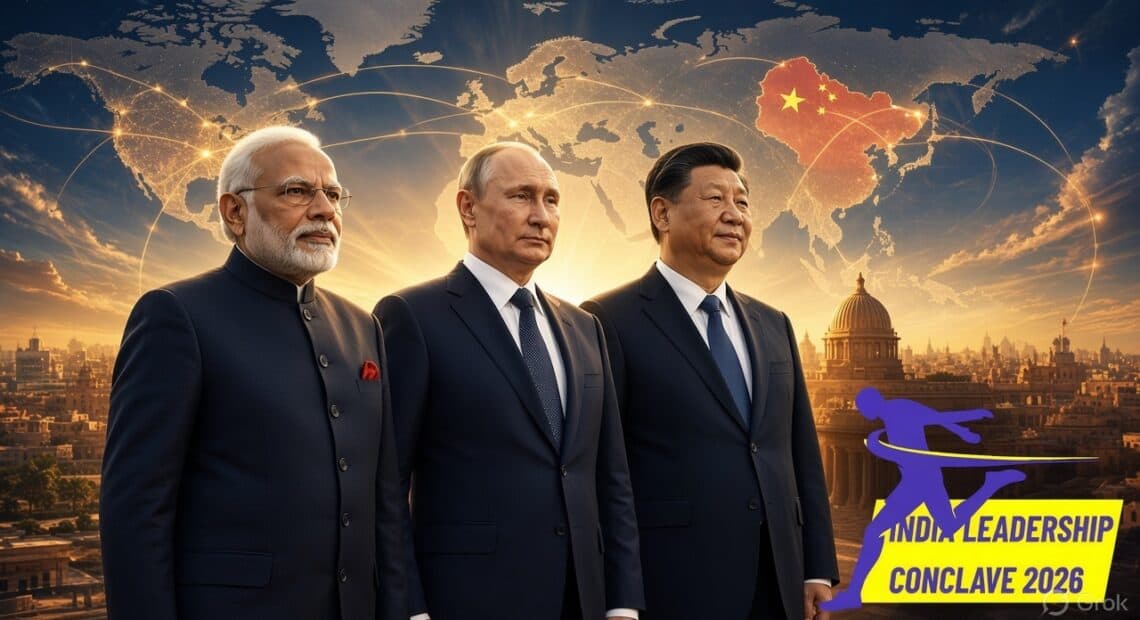
The summit produced optics of collegiality among Modi, Putin, and Xi, and reinforced BRICS as a platform for the Global South to push for greater voice in global governance, UN Security Council reform, and resistance to unilateral economic measures. Leaders emphasised multipolarity, reform of existing institutions rather than their replacement, and practical cooperation on payments, supply chains, and development finance.
However, independent analyses and the declaration’s careful wording indicate the outcomes remain largely functional and consensus-driven rather than a deeper strategic unification. BRICS did not evolve into a military alliance, a common currency, or an explicitly anti-Western bloc. Language on Ukraine was absent or neutral; positions on West Asia emphasised restraint and maritime security without naming specific parties in ways that would fracture the group.
India continued to stress strategic autonomy. As the only Quad member inside BRICS, New Delhi used the platform to advance Global South priorities while preserving space for engagement with Western partners. Border issues with China were addressed in measured terms focused on stabilisation rather than resolution. Energy and defence ties with Russia were deepened on commercial grounds, consistent with long-standing patterns, without signalling a shift away from diversified partnerships.
Analysts note that many ambitious proposals—such as systematic follow-up mechanisms and deeper trade integration—will face implementation tests under China’s incoming 2027 chairship. The declaration’s breadth reflects the difficulty of binding an increasingly heterogeneous membership of 11 full members plus partners.
In short, India’s 2026 BRICS chairship demonstrated convening power, agenda-setting capacity, and the ability to extract consensus language on priorities important to New Delhi (counter-terrorism, digital public goods, development finance). It strengthened practical cooperation and India’s profile as a bridge within the Global South. It did not, however, create a new unified geopolitical axis with China and Russia. The relationship remains one of selective partnership within a multipolar framework—useful, limited, and still shaped by bilateral frictions and competing interests.
“India’s 2026 BRICS chairmanship proved that true leadership is not about choosing sides, but about creating space where divergent powers can still find common ground. Under Prime Minister Modi, New Delhi turned a fractured grouping into a platform of practical outcomes — from counter-terrorism consensus to digital and economic cooperation — without sacrificing strategic autonomy. This is the India Leadership Conclave spirit: measured strength, inclusive vision, and results that speak louder than rhetoric.”
said Dr. Satya Brahma, Chairman & Editor-in-Chief, Network 7 Media Group & Founder, India Leadership Conclave
The true measure of these outcomes will lie in delivery after the leaders leave New Delhi.
Author

Related Posts
Satya Brahma’s Vision India
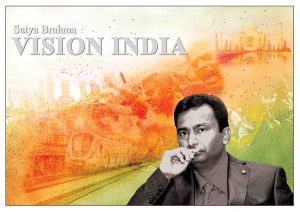
Photo Gallery