Odisha has long been a state where regional identity and national influence intersect. From the dominance of regional parties to the growing footprint of national players, the political narrative is undergoing a transformation. The younger generation is demanding transparency, accountability, and development-driven governance, while traditional power centers are recalibrating their strategies to stay relevant.
Naveen Patnaik recently declared that the “BJD will exist for 100 years.” This isn’t just a morale booster; it’s a recognition that the “Majhi Model” has successfully disrupted the BJD’s 24-year-old script.
A Year of Disruption, A Legacy Unshaken
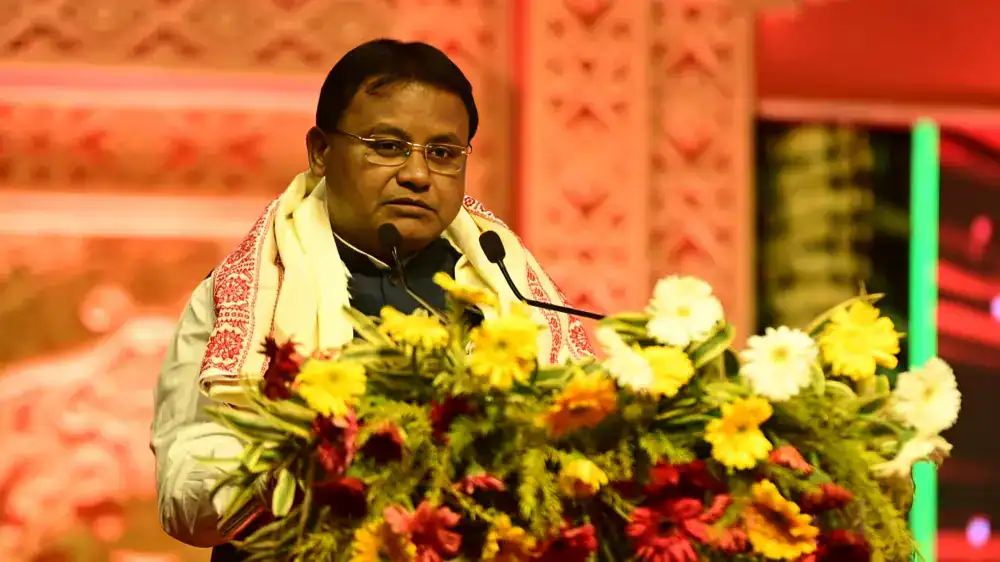
When Mohan Charan Majhi became Odisha’s first BJP Chief Minister in June 2024, it was hailed as a historic break from Naveen Patnaik’s 24-year dominance. The BJP projected Majhi as the People’s Chief Minister. Yet, one year later, the narrative is layered: Majhi has delivered on promises, but Naveen Patnaik continues to command unmatched mass appeal. And behind the scenes, another figure has emerged—V. K. Pandian, the trusted aide whose influence has grown in the shadow of Naveen’s failing health. Majhi’s first year has undeniably disrupted Odisha’s political axis, but the BJP’s propaganda of him being the “People’s Chief Minister” has not eclipsed Naveen Patnaik’s enduring mass leadership. Patnaik’s legacy of welfare-driven governance and emotional connect remains a formidable force, compelling the BJD to recalibrate its comeback strategy while reminding BJP that governance credibility cannot be manufactured overnight.
For a year, the airwaves of Odisha have been thick with a carefully crafted propaganda: the image of Mohan Charan Majhi as the “accessible son of the soil,” a man who listens where his predecessor merely observed. But as the honeymoon period of the BJP’s historic win settles into the grit of daily governance, a more complex reality is emerging.
While Majhi occupies the office, Naveen Patnaik continues to occupy the state’s collective psyche. The BJP’s “People’s CM” tag is facing its toughest test: the unshakeable, silent devotion of a population that still views Patnaik not as a former politician, but as a guardian.
The Pandian Factor –
Naveen Patnaik’s health visibly declining, many believe Vairab Kartikeyan Pandian —the former bureaucrat turned political strategist—is the one calling the shots. Though not in the front line, his imprint on BJD’s decisions is unmistakable.
Several party workers and leaders feel marginalized, arguing that Pandian’s dominance has reduced their relevance.
His wife, Sujata Pandian, retired from bureaucracy after BJD’s defeat, symbolizing a retreat from formal power but reinforcing the perception of a family-centered influence.
Can Pandian emerge stronger? His organizational skills and proximity to Naveen give him leverage, but the lack of electoral legitimacy and resentment among sidelined leaders remain formidable obstacles.
The Propaganda of Accessibility
The BJP’s primary weapon against the BJD legacy has been the contrast in “reach.”
- The “Plastic Chair” vs. The “Ivory Tower”: Every image of Majhi sitting in a village or reopening the CM’s Grievance Cell is a deliberate strike at Patnaik’s later years, which were perceived as bureaucrat-locked.
- The Tribal Identity: By emphasizing Majhi’s Santali roots, the BJP has tried to frame him as the “true” Odia, implying that Patnaik’s 24 years were an era of “alien” governance.
The Reality Check:
Network 7 Media’s ground reports suggest that “accessibility” does not always equate to “authority.” While people can now meet their CM, there is a growing murmur that the decisive, silent efficiency of the “Naveen era” is missing. The BJD has successfully framed Majhi’s frequent consultations with New Delhi as a loss of Odisha’s autonomy—a narrative that is beginning to sting.
The “People’s CM” title is a self-awarded badge that Mohan Majhi is working hard to earn. However, a leader’s stature is not built by the absence of his predecessor, but by the weight of his own legacy.
Mohan Majhi has successfully opened the doors of the secretariat, but he has yet to close the hearts of the people to Naveen Patnaik. As long as the “Naveen Niwas” remains the emotional pilgrimage site for millions, Majhi’s tenure will be viewed not as a new book, but as a difficult second chapter.
The propaganda is loud, but the silence of the Odia voter is louder. The battle for Odisha’s soul is far from over.
As we move into 2026, the political landscape of Odisha is witnessing a fascinating “clash of archetypes.” Based on current ground trends, here is the Network 7 People’s Ground Results Summary, breaking down how the Majhi administration’s first year has landed across the state’s distinct regions.
Mohan Majhi has successfully shifted the politics of Odisha, but he hasn’t yet fully shifted the culture. While the “People’s CM” tag is effective in Western Odisha and tribal belts, the Coastal heartland still treats him as a “temporary tenant” in a house built by Biju and Naveen Patnaik.
For over two decades, the political map of Odisha was painted in the steady, unyielding green of the Biju Janata Dal (BJD). But today, the wind blowing from the Bay of Bengal carries a different scent—one of seismic transition. The 2024 elections didn’t just change the government; they shattered a monopoly, signaling a profound shift in the Odia sub-national identity and the state’s democratic architecture.
The Saffron Surge: From Margin to Mandate
The rise of the Bharatiya Janata Party (BJP) in Odisha is not a sudden accident of history; it is the culmination of a decade-long “slow-burn” strategy. By successfully weaving together national aspirations with the threads of Odia Asmita (Odia pride), the BJP dismantled the BJD’s “fortress” image.2
The party moved beyond its traditional strongholds in Western Odisha to dominate the coastal heartlands, fueled by:
- The “Outsider” Narrative: A potent campaign against the perceived dominance of non-Odia influence within the BJD’s inner circle.
- Cultural Resonance: Leveraging issues like the “missing keys” of the Jagannath Temple’s Ratna Bhandar to connect with the deep-seated spiritual consciousness of the electorate.
- Aspirational Youth: For a generation that knew only one Chief Minister, the promise of “Double Engine” growth and job creation outweighed the comfort of existing welfare schemes.
The decline of the BJD is perhaps the most poinant chapter in this saga. After 24 years of stability, the party finds itself at a crossroads. The loss was not merely of seats—dropping from 112 to 51 in the Assembly—but of its invincibility.
The cracks are now visible. Internal factionalism, long suppressed by the towering presence of Naveen Patnaik, has begun to surface. With the suspension of key MLAs and murmurs of a new regional outfit emerging, the BJD faces an existential question: Can it survive as a regional force without the absolute authority of its patriarch? The transition from a “ruling machine” to a “fighting opposition” has proven difficult, as the party struggles to redefine its identity in a post-Naveen era.
Odisha is no longer a “stable” monolith. It has transformed into a dynamic, competitive laboratory of Indian democracy. The BJP now carries the heavy burden of incumbency and the challenge of governing a complex, culturally rich state. The BJD is fighting for its legacy and its life. And the Congress is looking to reclaim its lost heritage.
As the state moves toward the 2026 local elections, one thing is certain: the Odia voter is no longer a silent spectator. The era of predictable politics is over, and a new, more contested chapter has begun.
This research report examines the complex power dynamics currently reshaping Odisha’s political landscape, focusing on the influential Pandian couple and the existential crisis facing the Biju Janata Dal (BJD).
The Invisible Power: Decoding the Pandian Nexus
For over a decade, V.K. Pandian was more than just a private secretary; he was the primary architect of the Odisha government’s “5T” (Transparency, Technology, Teamwork, Time, and Transformation) framework. His wife, Sujata Pandian (Sujata R. Karthikeyan), was equally pivotal, leading the Mission Shakti department, which organized nearly 70 lakh women into self-help groups (SHGs).
- The Power Couple: While V.K. Pandian managed the Chief Minister’s Office (CMO) and infrastructure, Sujata built a massive, grassroots loyalty base among women—a demographic that served as the BJD’s “silent vote bank” for years.
- Voluntary Retirement: In a coordinated retreat following the BJD’s 2024 electoral defeat, both have now exited formal service. V.K. Pandian took voluntary retirement in October 2023 to join the BJD, while Sujata Karthikeyan followed suit, with her retirement becoming effective on March 13, 2025.
- The Shadow Influence: Despite V.K. Pandian’s public announcement of “withdrawing from active politics” in June 2024, reports from late 2025 and early 2026 suggest he remains a “surrogate” decision-maker. As Naveen Patnaik faces health challenges and spends significant time in Delhi, Pandian is still widely viewed as the person holding the “decree” over BJD affairs.5
Why Naveen Patnaik Remains Mum
The former Chief Minister’s silence regarding Pandian’s polarizing role is a calculated but risky political stance.
- Protective Barrier: Patnaik has consistently defended Pandian as a man of “integrity and honesty,” insisting he was an implementer of vision rather than a successor.6 By remaining mum on the “outsider” narrative, Patnaik avoids validating the BJP’s campaign that he has lost control.
- Lack of Alternative: After 24 years of centralized power, there is no “Plan B.” Patnaik’s silence reflects a deep-seated reliance on the only administrative and political machinery he trusts, even if that machinery is now a liability for the party’s public image.
- The “Dhritarashtra” Comparison: Critics and some disgruntled BJD veterans have begun comparing Patnaik to the mythological King Dhritarashtra—blind to the faults of his “Man Friday” while the party structure crumbles around him.7
VK Pandian: Force or Diminishing Force?
V.K. Pandian’s current status is a paradox: he is administratively omnipotent but politically radioactive.
- A Force Within: He still controls the BJD’s strategy, communication, and internal resource allocation. As long as Patnaik is the party head, Pandian remains the gatekeeper.
- A Diminishing Force Externally: The “Outsider” (non-Odia) label has stuck.8 In the eyes of the electorate and the rising BJP, he is the symbol of why the BJD lost. His presence acts as a lightning rod for opposition attacks, making it difficult for the BJD to win back coastal voters.
The Future of BJD: The Succession Crisis
As of early 2026, the Biju Janata Dal is facing its most significant threat since its inception in 1997.
- Internal Rebellion: The party is currently battling “internecine conflict.”9 With Patnaik’s health being a major factor, senior leaders like Arun Sahoo and others have begun to voice discontent. The party has already seen suspensions of veteran leaders, signaling a breakdown in the once-monolithic discipline.
- The Split Risk: Without a clear, “son-of-the-soil” successor, the BJD is at high risk of a split. Analysts suggest that if a non-Patnaik (or a Pandian-backed) leader is forced upon the party, a large faction may defect to the BJP or attempt to form a new regional outfit.
- The Identity Vacuum: The BJD’s future depends on whether it can pivot back to its roots of “Odia Pride” without Naveen Patnaik’s personal charisma. Without him, the BJD risks becoming a “placeholder” party that slowly bleeds its cadre to a resurgent Congress and a dominant BJP.
Author

Related Posts
Satya Brahma’s Vision India
Photo Gallery