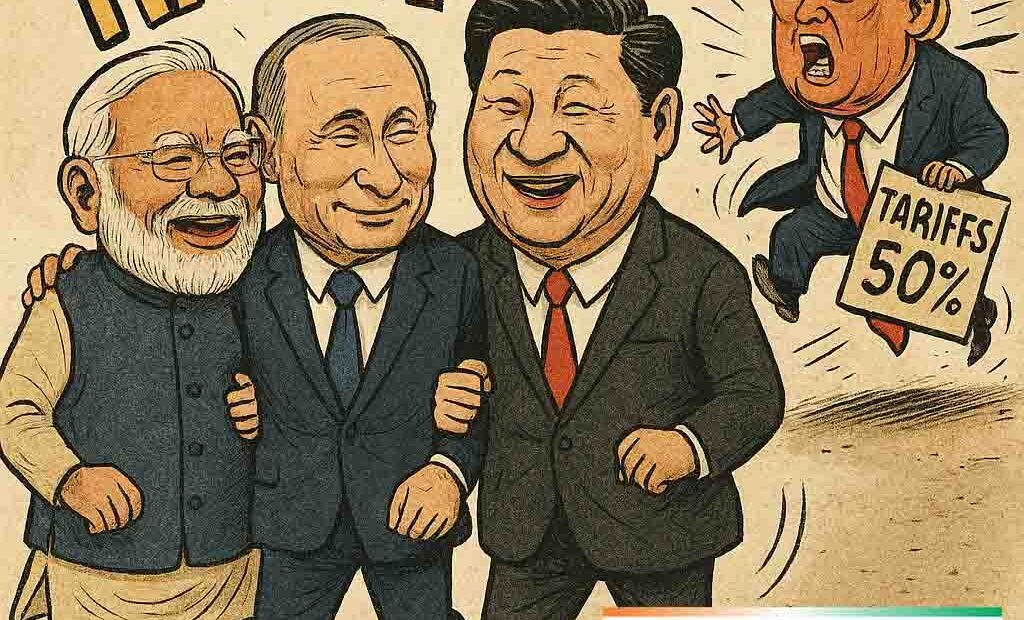
In a geopolitical twist few saw coming, U.S. President Donald Trump’s aggressive tariff regime has inadvertently catalyzed a rare diplomatic convergence: Indian Prime Minister Narendra Modi and Chinese President Xi Jinping standing side-by-side at the Shanghai Cooperation Organisation (SCO) Summit in Tianjin. The moment, captured in a firm handshake and a Mandarin tweet from Modi, signals a recalibration of Asian power dynamics—despite unresolved border tensions and China’s overt support to Pakistan following the barbaric Pahalgam terror attack that claimed 26 Indian lives.
Modi–Putin–Xi Axis Rattles Trump’s Tariff Playbook: India’s SCO Pivot and the Price of American Dependence.
SCO Summit: Gains for India Amid Shadows of Conflict
India’s participation in the 25th SCO Summit was marked by strategic assertiveness and calibrated outreach. Key takeaways include:
- Counter-Terrorism Consensus: Modi secured strong condemnation from SCO members over the Pahalgam attack, with a clear call to hold sponsors of cross-border terrorism accountable.
- Border Stability Dialogue: Modi and Xi agreed to maintain peace along the Line of Actual Control (LAC), with renewed mechanisms for disengagement and military coordination.
- Connectivity & Trade: India pushed for expansion of the Chabahar Port and the International North-South Transport Corridor, signaling intent to bypass chokepoints and diversify trade routes.
- Civilizational Diplomacy: Modi proposed a Civilizational Dialogue Forum under SCO to deepen cultural ties and people-to-people engagement.
- Multilateral Reform: India and China found common ground on reforming global institutions like the UN and WTO, reflecting shared frustration with Western-dominated governance models.
Can India Trust China?
The optics of warmth between Modi and Xi belie a deeper undercurrent of strategic caution. Despite gestures like resuming direct flights and the Kailash Mansarovar Yatra, India remains wary:
- Border Disputes Persist: China’s presence in disputed territories and its infrastructure push in Pakistan-occupied Kashmir via CPEC remain red flags.
- Trust Deficit: India has outlined three prerequisites—mutual respect, mutual interest, and mutual sensitivity—for any forward movement.
- Symbolism vs Substance: Experts warn that while the SCO meeting may mark a thaw, it’s far from a reset. The relationship is still defined by “cautious optimism”.
Trump’s 50% Tariff Shock: Modi’s Options
Trump’s unilateral imposition of 50% tariffs on Indian exports—citing Russian oil imports and trade imbalances—has jolted India’s manufacturing ambitions. Modi faces a complex matrix of choices:
| Option | Strategic Implication |
|---|---|
| Pivot to China & Russia | Risky but pragmatic; may dilute U.S. leverage but deepen regional integration |
| Boost Domestic Consumption | Leverages India’s vast internal market (80% of production); absorbs export shocks |
| Diversify Export Destinations | Accelerate FTAs with EU, UK, Peru; reduce dependency on U.S. market |
| Trade Retaliation or WTO Appeal | Legally viable but diplomatically fraught; risks escalation |
| Incentivize MSMEs & Job Protection | Critical to cushion sectors like textiles, gems, and seafood from collapse |
Modi has vowed “no compromise” on India’s economic sovereignty, signaling resilience amid pressure.
India’s Business Position in 2025: Resilient, Rising, Recalibrating
Despite external shocks, India’s economic fundamentals remain robust:
- 4th Largest Economy: India has overtaken Japan with a nominal GDP of $4.18 trillion.
- Fastest-Growing Major Economy: Projected growth of 6.4–6.7% in FY26, driven by consumption and services exports.
- FDI & Digital Surge: Over $1 trillion in cumulative FDI; UPI processed 172 billion transactions in 2024.
- Manufacturing Push: PLI schemes and tax incentives aim to offset export losses and boost domestic production.
India’s strategic balancing act—between Washington’s tariffs, Beijing’s overtures, and Moscow’s energy corridors—is shaping a new narrative: one of assertive autonomy in a multipolar world.
“Asia’s future will be written not through rivalry, but through resolve,” Modi declared in Tianjin. Whether that resolve translates into lasting trust or tactical alignment remains the defining question of India’s next chapter. In a world increasingly defined by fractured alliances and transactional diplomacy, the Shanghai Cooperation Organisation (SCO) Summit in Tianjin delivered a moment of geopolitical theatre: Prime Minister Narendra Modi, Russian President Vladimir Putin, and Chinese President Xi Jinping walking shoulder-to-shoulder, exchanging smiles, handshakes, and strategic whispers. The image wasn’t just symbolic—it was a message. And it was aimed squarely at Washington.
Modi’s Snub: The Phone Call That Triggered Trump’s Tariff Tsunami
According to multiple reports, the deterioration in India–U.S. ties can be traced to a single explosive phone call on June 17:
- Trump’s Nobel Bid: Trump reportedly asked Modi to endorse his nomination for the Nobel Peace Prize, claiming he had brokered a ceasefire between India and Pakistan post the Pahalgam terror attack.
- Modi’s Pushback: Modi firmly rejected the claim, stating the ceasefire was a bilateral decision with no U.S. involvement. He declined to support Trump’s Nobel ambitions.
- Diplomatic Fallout: Modi refused four subsequent calls from Trump, skipped a White House visit, and rejected a proposed handshake with Pakistan’s Army Chief.
- Tariff Retaliation: Within weeks, Trump imposed a 50% tariff on Indian exports, widely seen as punishment for Modi’s defiance.
This episode underscores the fragility of personal diplomacy and the dangers of ego-driven geopolitics.
Lessons for India: Rethinking U.S. Investment Strategy Under Trump
India’s deep economic engagement with the U.S.—once hailed as a strategic hedge—is now under scrutiny. Key lessons include:
| Lesson | Implication |
|---|---|
| Avoid Overdependence | $87B in exports now face 50% tariffs; diversification is urgent |
| Transactional Risk | U.S. policy under Trump is volatile, driven by personal grievances |
| Strategic Autonomy Matters | India must balance ties with U.S., Russia, China without compromising sovereignty |
| Domestic Resilience | Boosting MSMEs, internal consumption, and alternate markets is critical |
| Diplomacy ≠ Deference | Assertive, values-based diplomacy is essential—even with allies |
India’s investments in U.S. sectors like textiles, gems, and seafood have taken a massive hit. Exporters are now pivoting to Europe, ASEAN, and the UAE, while the government considers retaliatory tariffs and domestic incentives.
India’s Global Business Position: Resilient but Recalibrating
Despite the turbulence, India remains a formidable economic force:
- 4th Largest Economy: Surpassing Japan, with a GDP of $4.18 trillion
- FDI Magnet: Over $1 trillion in cumulative FDI, with rising interest from EU and ASEAN
- Digital Powerhouse: UPI processed 172 billion transactions in 2024
- Manufacturing Push: PLI schemes and Make in India 2.0 aim to offset export losses
India is no longer just reacting—it’s recalibrating. The SCO Summit may have been a diplomatic spectacle, but it also marked a strategic pivot: from dependence to autonomy, from deference to assertion.
“India will not be arm-twisted into submission. Our partnerships must be built on respect, not reward,” Modi reportedly told aides after the Trump call fallout.
Author
Satya Brahma’s Vision India
Photo Gallery