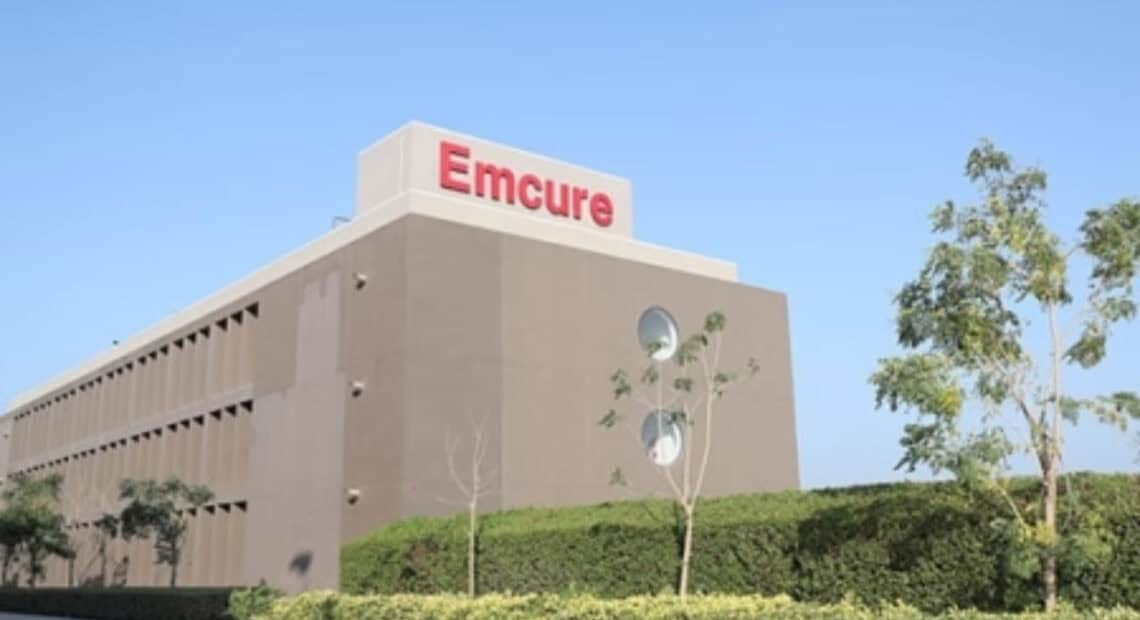
An executive ousting, an entire dermatology unit in freefall, a mass exodus of 950 employees, and a high-stakes EOW criminal complaint. As Emcure hits the $1.1 billion milestone, an explosive internal war threatens to rewrite the rules of domestic pharma dominance.
As boardroom battles intensify, Emcure Pharmaceuticals finds itself at the epicenter of a high‑stakes corporate storm — where power struggles, fractured alliances, and a ₹75‑crore showdown are reshaping the future of one of India’s most prominent pharma giants.
Publicly, Emcure Pharmaceuticals Ltd is celebrating a historic milestone. In May 2026, the Pune-headquartered multinational proudly announced it had crossed the coveted $1 billion revenue mark, posting a consolidated revenue of ₹9,204 crore for FY26. Powered by explosive 22.2% growth in international markets, the company’s financial sheet looks armor-plated.
But behind the clinical precision of its investor presentations lies a gripping, high-stakes corporate thriller.
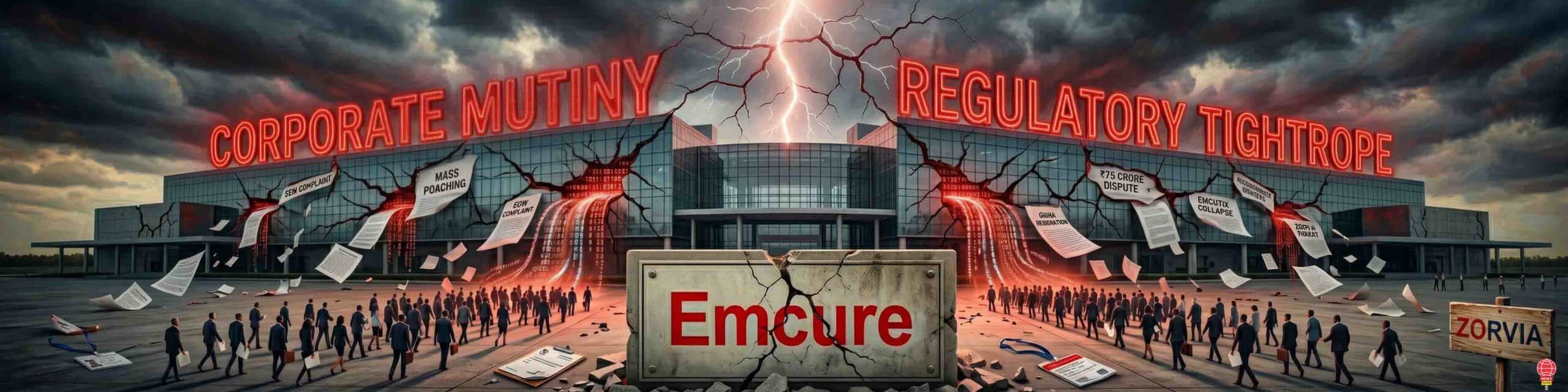
Over the last several months, a series of sudden executive departures, allegations of forced corporate takeovers, and unprecedented mass employee walkouts have sent shockwaves through the Indian pharmaceutical industry. The friction culminated in May 2026, with Emcure filing a massive ₹75 crore corporate fraud, mass poaching, and intellectual property theft lawsuit through Mumbai’s Economic Offences Wing (EOW).
This investigation untangles the web of internal power struggles, the dismantling of legendary subsidiaries, and the legal crossfire currently reshaping Emcure’s domestic empire.
PART I: The Unraveling of a 20-Year Legacy
To understand the chaos of 2026, one must look back to October 1, 2025—the day the fault lines first ruptured. On that date, Mr. Prakash Kumar Guha abruptly resigned as Managing Director of Zuventus Healthcare Limited.
To industry insiders, Guha’s sudden departure without an official, transparent explanation from Emcure was nothing short of a seismic event.
The Architect of a Powerhouse
Zuventus was not just another subsidiary; it was a crown jewel. Incorporated in 2002 as a joint venture between a Satish Mehta-led Emcure and three founding partners—Prakash Kumar Guha, Shriram Balasubramanian, and CV Shetty—Zuventus was Guha’s life’s work.
Over more than two decades, Guha earned a reputation as an industry visionary. He systematically transitioned Zuventus from a modest, dependent trading and marketing firm (initially set up to distribute Emcure’s products) into an independent, self-sustaining pharmaceutical powerhouse.
[2002: JV Formed] ──> [2005: ₹100 Cr] ──> [2007: ₹200 Cr] ──> [2022: ₹2,000 Cr Turnover]
Under Guha’s stewardship, the company expanded fiercely into high-value, defensive therapeutic segments including cardiovascular and diabetic therapies. It built state-of-the-art manufacturing facilities and distribution networks in Sikkim and Bengaluru. By September 2024, data from AIOCD-AWACS placed Zuventus at an enviable 9th rank in the Directly Covered Market and 25th overall among all pharmaceutical companies operating in India.
The Cost of Full Control
Why would a parent company disrupt an engine of such remarkable growth? The answer, sources whisper, lies in absolute financial consolidation.
In mid-2025, Emcure moved to acquire the remaining 20.42% minority stake held by the founding pioneers for a staggering ₹724.9 crore, effectively turning Zuventus into a wholly-owned subsidiary.
With full financial control achieved, the driving seat was abruptly pulled out from under Prakash Kumar Guha. Industry speculation is rampant that Guha was forced out by a parent company eager to fully integrate Zuventus’ revenues and dictate its operational cash flows. But as Emcure would soon learn, dismantling a legacy built on deep personal loyalty carries a devastating price.
PART II: Collateral Damage – The Emcutix Collapse
As the friction boiled over at Zuventus, a parallel crisis was quietly quietly decimating another Emcure venture: Emcutix Biopharmaceuticals Limited.
Exclusively focused on the high-growth dermatology and aesthetic care sector in India, Emcutix was spearheaded by its CEO and founder, G. Sathya Narayanan. A seasoned veteran of the specialty pharma space, Narayanan proved the viability of the business almost instantly, clocking an impressive ₹60 crore turnover in its very first year.
Yet, mimicking the opaque management shifts at Zuventus, Narayanan suddenly exited the company. The fallout was immediate and catastrophic:
- Mass Resignations: More than 50 key personnel and specialized sales members walked out of the door following Narayanan’s departure.
- Revenue Bleeding: Deprived of its founding architect and core field force, Emcutix’s revenue began a steep, unmitigated dive.
Just as with Guha, Emcure maintained a strict wall of corporate silence regarding the collapse of the Emcutix leadership, leaving investors and partners to read between the lines.
PART III: The War of 2026 – Mass Poaching and the EOW Lawsuit
By May 2026, the under-the-surface tension erupted into open legal warfare. Emcure’s Chief Financial Officer, Tajuddin Sabir Shaikh, marched into Mumbai’s Economic Offences Wing (EOW) to lodge a criminal complaint alleging a orchestrated sabotage campaign targeting Zuventus Healthcare.
The lawsuit outlines a breathtaking ₹75 crore corporate conspiracy based on four core pillars:
Inside the ₹75-Crore EOW Complaint:
- Mass Poaching: In an unprecedented industry exodus, nearly 950 employees resigned from Zuventus in a concentrated window of time to join a direct, newly emerging market rival.
- IP & Data Theft: Emcure alleges that former stakeholders systematically stole proprietary intellectual property and misused highly confidential business data to divert established prescription channels.
- Breach of Contract: The exodus and corporate maneuverings allegedly flagrantly violated strict non-compete and non-solicitation clauses embedded in the original Shareholders’ Agreement (SHA).
- Severe Financial Disruption: The sudden loss of nearly a thousand field agents paralyzed domestic operations, racking up an estimated initial damage of ₹75 crore.
Enter Zorvia: The Defiant New Challenger
As rumors swirled linking the mass migration of staff to an emerging entity named Zorvia, the market panicked. However, Zorvia has aggressively pushed back against being dragged into Emcure’s internal civil war.
In a sharply worded, defensive public stance, Zorvia declared that it:
“…operates independently, under its own name and identity, and has no corporate, commercial or operational association with Zuventus or any other pharmaceutical company.”
Vowing to protect its corporate goodwill from being collateral damage in Emcure’s litigation, Zorvia’s management confirmed they are actively pursuing appropriate legal action and remedies against defamatory statements that threaten their standing with channel partners.
PART IV: The Financial X-Ray – Can the International Engine Absorb the Shock?
For pharma analysts, the ultimate question is whether this internal bloodletting will derail Emcure’s hard-won market capitalization. The numbers from the Q4 FY26 earnings call paint a vivid picture of a company using its global reach to absorb a brutal domestic blow.
- The Domestic Hit
The mass exit of 950 sales professionals was heavily felt in the fourth quarter. Emcure’s domestic sales force suffered a staggering 30% attrition rate during the integration process. Consequently, domestic revenue in Q4 FY26 slowed to a crawl, growing just 5.2% YoY to ₹977 crore.
However, the sheer resilience of Emcure’s defensive therapies—specifically Women’s Health, Cardiac, CNS, and Oncology—allowed the domestic business to close the full fiscal year with a stable 10% growth, totaling ₹4,027 crore.
- The International Cushion
While the Zuventus dispute burned at home, Emcure’s international business acted as a massive financial firewall. Expanding by 22.2% to ₹5,177 crore due to aggressive product rollouts in Europe and Canada, the overseas segment completely insulated the group’s bottom line.
FY26 Financial Performance & Structural Health
| Metric | FY26 Performance | Impact of Zuventus Dispute / Attrition |
| Domestic Revenue | ₹4,027 Cr (+10% YoY) | Softened Q4 growth (+5.2%) but fully stabilized by April 2026. |
| International Revenue | ₹5,177 Cr (+22.2% YoY) | Completely insulated; served as the primary group growth engine. |
| EBITDA Margin | 19.4% (+83 bps expansion) | Enhanced by rising field productivity per representative (₹7 lakhs). |
| Balance Sheet Risk | 0.24x Debt-to-Equity | Low leverage provides ample room to cover legal costs or strategic restructuring. |
PART V: The Outlook for FY27 and Hidden Blind Spots
In their May 2026 earnings call, Emcure’s leadership put on a brave front. They assured institutional investors that the “integration friction” of Zuventus has been resolved through swift, aggressive executive hires. According to management, April 2026 operations returned entirely to the tracks, and they confidently issued a 10% to 15% revenue growth guidance for FY27, paired with an anticipated 75 to 100 basis points expansion in EBITDA margins.
However, independent pharma analysts warn of critical blind spots that investors must closely monitor in the coming quarters:
- Prescription Capture Retention: While hiring new sales reps is easy, reclaiming deeply entrenched relationships with doctors—built over 20 years by Prakash Kumar Guha and his departed team—is an uphill battle. The ₹75 crore lawsuit is less about the money and more of a desperate legal dam to prevent premium prescription channels from diverting to rivals.
- Working Capital Ballooning: As Emcure chases high international growth to cover up domestic scars, its inventory and working capital cash absorption have started to swell. If domestic cash generation slows due to prolonged legal friction, cash flow tightness could manifest by mid-2027.
The Ultimate Test of Institutionalization
Emcure Pharmaceuticals has successfully evolved into a $1.1 billion multinational corporation, but its current crisis serves as a stark cautionary tale for the Indian pharma sector. It highlights the volatile dangers of transitioning from entrepreneur-led, relationship-driven joint ventures to institutionalized, wholly-owned corporate operations.
Satish Mehta and the Emcure leadership have proven they have the international muscle to withstand a domestic mutiny. But as the EOW investigation unfolds and the legal battles with former stakeholders and independent entities like Zorvia intensify, the true cost of “buying out” a legacy has yet to be fully calculated. Emcure has secured the corporate structure it wanted—now it must prove it can duplicate the growth that only the founders could once deliver.
At a time when India’s pharmaceutical sector is celebrated for its innovation and global reach, Emcure Pharmaceuticals Limited finds itself at the crossroads of triumph and trial.
Between May 6–15, 2026, the United States Food and Drug Administration (US FDA) conducted a cGMP inspection at Emcure’s formulations facility in Sanand, Gujarat. The inspection culminated in a Form 483 with seven procedural observations. While the company has clarified that these are procedural lapses rather than systemic failures, the development raises critical questions about compliance culture in one of India’s most prominent drugmakers.
Financial Strength vs. Regulatory Challenge
- Net Profit (Q4 FY2026): ₹243 crore (29% YoY growth)
- Revenue: ₹2,469.7 crore (16.7% YoY growth)
- EBITDA: ₹479.5 crore, margins at 19.4%
- International Sales: ₹1,493 crore (25.7% YoY growth)
- Domestic Sales: ₹977 crore (5.2% YoY growth)
The company’s stock reflected investor confidence, closing at ₹1,702.30 (+1.73%) on May 15, 2026, even as regulatory scrutiny loomed.
- Compliance vs. Credibility: FDA observations, even procedural, can cast shadows on global trust.
- Investor Sentiment: Market resilience suggests confidence in Emcure’s corrective capacity.
- Strategic Balance: Strong international momentum contrasts with slower domestic growth, hinting at a shift in focus.
- Sectoral Implication: The episode underscores the broader challenge for Indian pharma — balancing rapid expansion with uncompromising governance.
Emcure’s story is emblematic of India’s pharmaceutical paradox: dazzling financial growth juxtaposed with recurring regulatory alarms. The company’s response to the FDA’s observations will not only determine its own trajectory but will also serve as a litmus test for India’s credibility in global healthcare markets. As the world looks to India for affordable innovation, the question remains — can growth be sustained without governance lapses?
The Story Within a Story
An examination of the legal and financial history of Emcure Pharmaceuticals reveals that while the company has not faced major, definitive penalties for systemic “market manipulation” (such as stock price rigging), it has been entangled in notable global antitrust litigations, high-stakes domestic corporate fraud disputes, and short-term market volatility driven by public relations.
- Global Price-Fixing and Antitrust Litigation (US Generic Market)
The most significant legal challenge linking Emcure to structural market distortion belongs to the multi-year U.S. Generic Drug Price-Fixing Litigation.
- The Allegations: State Attorneys General across the United States filed sweeping antitrust complaints alleging that a cartel of global generic drug manufacturers engaged in systematic price-fixing, customer allocation, and bid-rigging to artificially inflate the prices of generic drugs.
- Emcure’s Involvement: Emcure Pharmaceuticals, Ltd. was specifically named alongside dozens of other dominant global and Indian generic manufacturers (such as Teva, Sandoz, and Taro) in the sprawling multi-district litigation. The complaints alleged that companies coordinated through industry trade shows and private communications to split market shares and avoid competitive price-cutting, thereby manipulating the generic drug marketplace.
- Commercial, Patent, and Trademark Litigations
Like most large-scale pharmaceutical firms, Emcure is continuously involved in commercial legal battles to protect its portfolio or challenge competitors:
- Trademark Infringement: Emcure aggressively protects its brand equity. A notable domestic example includes Emcure Pharmaceuticals Ltd. v. Corona Remedies Pvt. Ltd., where Emcure successfully obtained interim injunctions protecting its blockbuster iron-deficiency brand, Orofer, against deceptively similar rival trademarks. Conversely, in early 2026, Emcure successfully secured an ex-parte injunction against an entity operating under the copycat name “Emsure Pharmaceutical.”
- Patent Disputes: Emcure has frequently clashed with global pharma giants (such as AstraZeneca over blood-thinner medications like Ticagrelor) to challenge generic entry barriers or negotiate launch timelines under patent law guidelines.
- Public Sentiment and Dalal Street Volatility (April 2026)
While not constituting illegal market manipulation by the company itself, Emcure’s stock experience on the National Stock Exchange (NSE) recently demonstrated how vulnerable its market valuation is to digital sentiment and executive public relations.
- The Incident: In late April 2026, Emcure shares bucked a positive broader market trend and slipped over 2.6% in intraday trading following a social media backlash.
- The Cause: The trigger was a viral online video posted by Emcure’s Executive Director, Namita Thapar, discussing the holistic health benefits of Namaz (Islamic prayer) as a full-body exercise. The video sparked widespread polarization, trolling, and boycott calls online.
- The Market Takeaway: Market analysts highlighted this event as a prime example of modern market dynamics, demonstrating how the personal public statements of high-profile promoters can instantly spill over into institutional investor sentiment and cause short-term stock pressure.
While Emcure has managed to successfully navigate its recent public listing and maintain strong domestic market positions, its historical inclusion in the US generic price-fixing lawsuits underscores the immense regulatory and antitrust risks facing Indian multi-nationals abroad.
Author


Satya Brahma’s Vision India

Photo Gallery