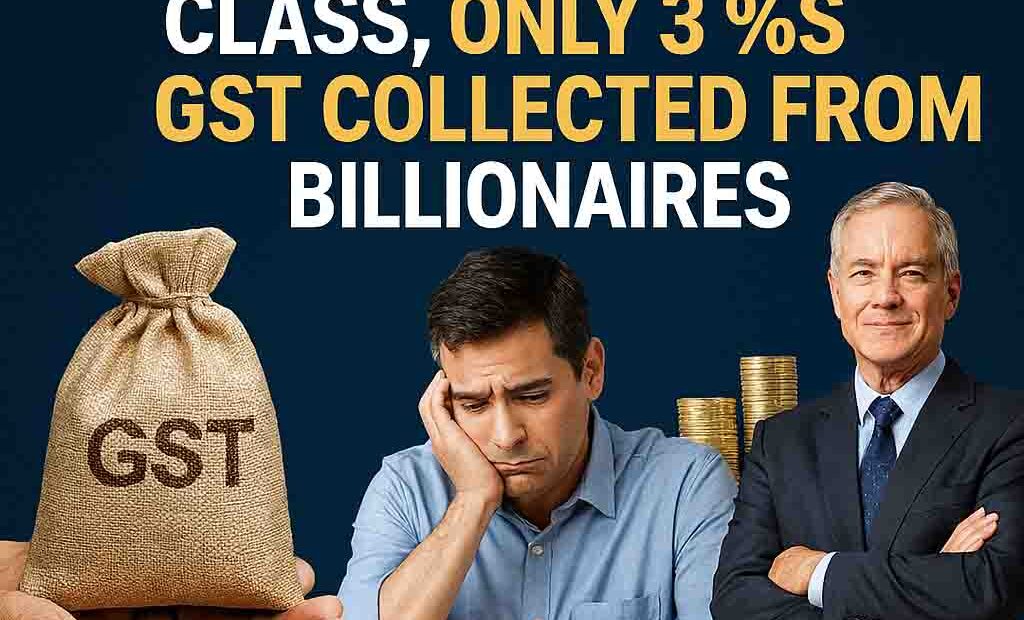
In a nation where economic inequality is widening, a startling revelation has emerged: 64% of India’s Goods and Services Tax (GST) revenue is effectively borne by the poor and middle class, while India’s billionaires contribute a mere 3%. This imbalance exposes a deep structural flaw in the country’s indirect taxation system—one that disproportionately burdens those with the least disposable income.
The Anatomy of GST: A Tax on Consumption, Not Wealth
GST, introduced in 2017, was hailed as a revolutionary reform to unify India’s fragmented tax system. But beneath its promise of simplification lies a regressive truth: GST is a consumption tax, not an income tax. That means the more you spend, the more you pay—regardless of how much you earn.
- Essential goods like unpackaged food grains, fruits, and vegetables are exempt from GST.
- Basic items such as edible oils, life-saving medicines, and fertilizers are taxed at 5%.
- Common services—mobile recharges, insurance premiums, banking, and transport—carry 18% GST, affecting middle-class households daily.
Who Pays What: The Hidden Burden
While the government does not maintain GST data by income group, analysis of consumption patterns and taxpayer segments reveals the skew:
| Segment | Estimated Share of GST Paid | Key Drivers |
|---|---|---|
| Bottom 50% (Poor) | ~30% | Daily consumption, indirect service use |
| Middle 40% (Middle Class) | ~34% | Housing, education, telecom, insurance |
| Top 10% (Affluent) | ~33% | Luxury goods, travel, high-end services |
| Billionaires (Top 0.01%) | ~3% | Minimal direct consumption, tax optimization |
This means the bottom 90% of Indians contribute nearly 64% of GST, while the ultra-rich—who own private jets, luxury estates, and offshore assets—barely register in the ledger.
Corporate GST vs Consumer GST: A Mirage of Equity
According to government data, large taxpayers (turnover > ₹250 crore) contribute a significant portion of GST. But this is corporate GST, which is passed on to consumers through pricing. In effect, the end-burden still falls on the buyer—often a middle-class or poor consumer.
The Policy Paradox: Flat Tax in a Unequal Society
India’s GST structure, with uniform rates on services and goods, fails to account for income disparity. Unlike progressive income tax, GST does not scale with wealth. A billionaire and a daily wage earner pay the same 18% GST on a mobile recharge.
This regressive design has led economists and activists to call for:
- Tiered GST rates based on product affordability
- Higher GST on luxury goods and services
- GST exemptions for essential digital services and insurance for low-income groups
Voices from the Ground
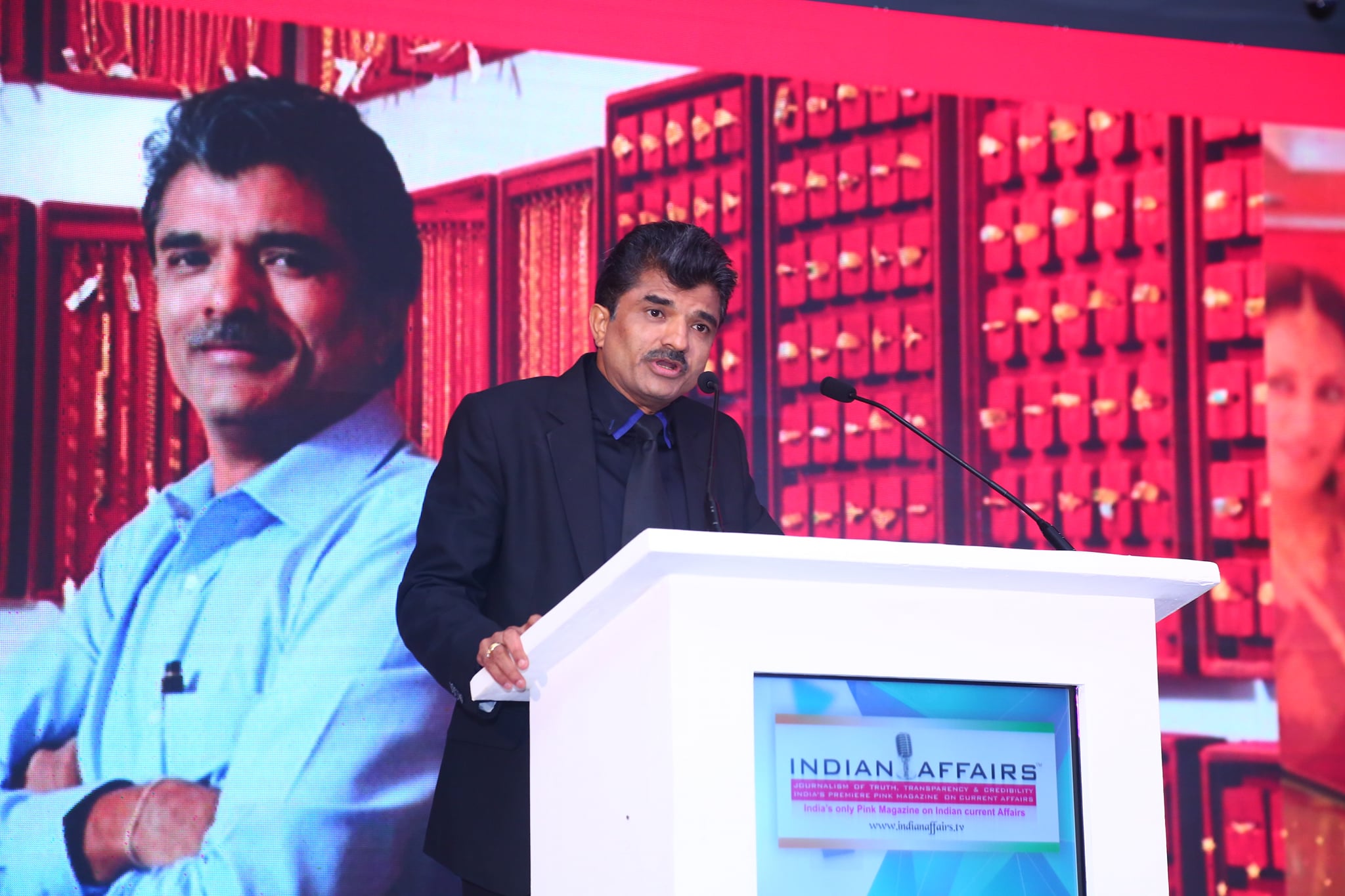
“GST has become a silent tax on survival. Every recharge, every medicine, every school fee carries a hidden cost,” says Dr. Satya Brahma, Founder of Indian Affairs TV. “It’s time we ask: who really benefits from this system?”
Reform or Regress?
As India prepares for its next fiscal overhaul, the GST debate must move beyond compliance and revenue. It must confront the moral question: Can a tax system be truly fair if it asks the poor to pay more than the rich?
Tax Equity & Governance Reform:
1. Structural Reset: Two-Slab Simplicity for Equity
The 56th GST Council meeting introduced a simplified two-slab structure—5% and 18%—replacing the previous four-tier system. This move aims to:
- Reduce classification disputes (e.g., “biscuit vs cake” litigation)
- Ease compliance for MSMEs and small traders
- Make taxation more transparent and predictable
This simplification is a governance win—but equity depends on how these slabs are applied across income-sensitive goods.
2. Rate Rationalization: Relief for the Bottom, Pressure on the Top
The new GST rates reflect a deliberate shift toward progressive consumption taxation:
| Category | Old Rate | New Rate | Impact |
|---|---|---|---|
| Soaps, toothpaste, Indian breads | 12–18% | 5% / Nil | Relief for middle-class households |
| Life-saving drugs & insurance | 5–12% | 0–5% | Healthcare affordability improved |
| Two-wheelers, small cars | 28% | 18% | Boost to mobility for middle class |
| Luxury goods, tobacco, yachts | 28% + cess | 40% | High deterrent for elite consumption |
This tiering aligns with tax equity principles, taxing luxury and sin goods more heavily while easing the burden on essentials.
3. Governance Reform: Digital Filing & Borderless Trust
The rollout of digital GST filing and e-invoicing has:
- Reduced corruption at state borders (e.g., Himachal’s truck delays and bribery eliminated)
- Accelerated refunds and compliance
- Enabled real-time revenue tracking, enhancing fiscal transparency
This digital backbone is a governance leap—but rural traders still face digital literacy gaps.
4. Sectoral Equity: From Hill States to Handlooms
The reforms have nuanced effects across sectors:
- Himachal Pradesh: Gains in tourism and agriculture, but loses hill-state tax incentives
- Textiles & Handicrafts: Affordable apparel taxed at 5%, luxury textiles at 18%
- Renewables vs Polluters: Solar and biogas taxed at 5%, coal raised to 18%
This sectoral targeting reflects environmental and regional equity, but demands central incentives to offset local revenue losses.
5. Policy Gaps & Advocacy Angles
Despite the reforms, key equity gaps remain:
- No income-based GST differentiation: A billionaire and a daily wage earner still pay the same rate on telecom or insurance.
- Digital divide in compliance: Small traders in tribal and backward regions risk exclusion.
- Excise revenue loss: States reliant on liquor/tobacco taxes must pivot to sustainable sectors.
These gaps offer fertile ground for editorial critique, summit debate, and policy advocacy.
Author

Related Posts


Satya Brahma’s Vision India

Photo Gallery