
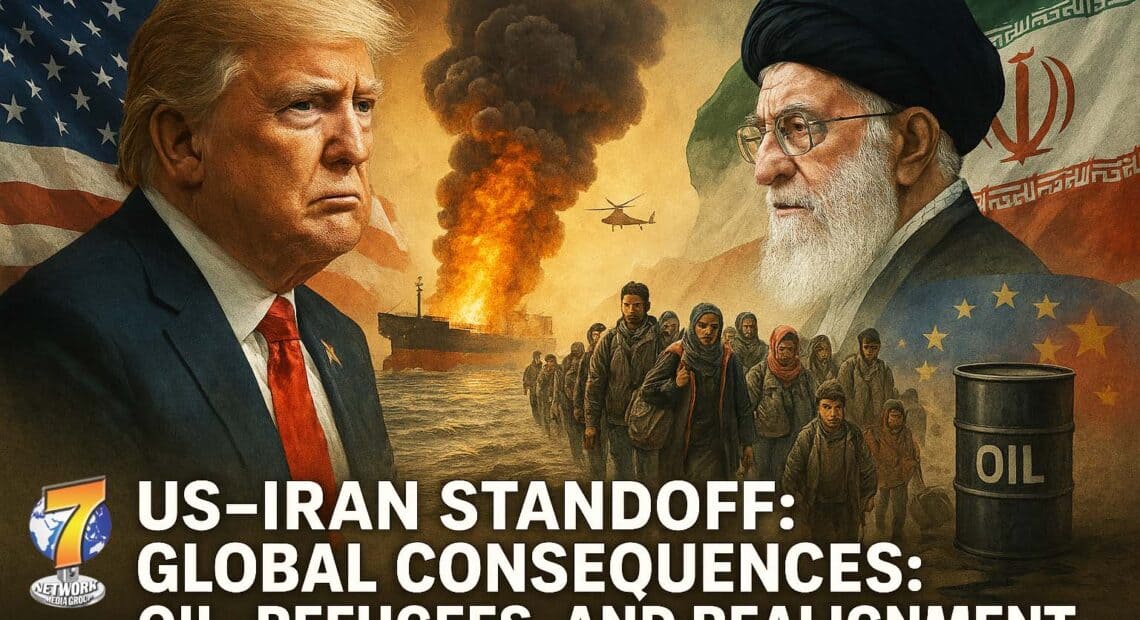
The Escalation
The confrontation between the United States and Iran has reached a dangerous peak in early 2026. President Donald Trump has signaled possible military action, deploying carrier strike groups to the Persian Gulf, while Supreme Leader Ali Khamenei has warned of “strong retaliation” if Iran is attacked. Negotiations over Iran’s nuclear program have stalled, and both sides are locked in a cycle of threats and counter-threats.
Trump’s Threat
Trump has reinforced the U.S. national emergency with respect to Iran, issuing executive orders that impose tariffs on countries trading with Tehran. His rhetoric frames Iran as a direct threat to U.S. national security, and he has made clear that military options remain on the table.
Khamenei’s Gameplan
Ali Khamenei’s strategy appears twofold:
- Deterrence through alliances: Iran is leveraging its “Axis of Resistance,” including Hezbollah and the Houthis, to project power beyond its borders.
- Calculated brinkmanship: By signaling readiness for retaliation, Iran seeks to raise the cost of U.S. intervention and rally domestic and regional support.
West Asia Peace Talks & Global Impact
- Regional instability: The Strait of Hormuz, a vital artery for global oil supply, is at risk. Any disruption could spike energy prices worldwide.
- Diplomatic paralysis: Peace talks in West Asia are overshadowed by the U.S.–Iran confrontation, leaving smaller states vulnerable to fallout.
- Global ripple effects: Europe fears refugee flows, Asia worries about energy security, and global markets brace for volatility.
The UN’s Role: Irrelevant or Undermined?
Iran has already warned the UN of retaliation, but both Trump and Khamenei appear dismissive of its authority. The Security Council is paralyzed by veto politics, and the UN’s inability to enforce resolutions underscores its declining relevance in conflicts where powerful leaders refuse to listen.
Consequences of War
If war breaks out:
- Humanitarian crisis: Civilian casualties and displacement across the Middle East.
- Economic shockwaves: Oil prices, trade routes, and global markets destabilized.
- Geopolitical realignment: Russia and China may exploit the vacuum, reshaping alliances and power balances.
This standoff is not just a bilateral feud—it is a global crisis with cascading consequences. The world watches as two uncompromising leaders test the limits of diplomacy, leaving the question: can international institutions still matter when power politics dominate?
Nations Supporting Each Side
| United States & Allies | Iran & Allies |
| Israel, Saudi Arabia, UAE, UK, France, NATO partners | Russia, China, Hezbollah (Lebanon), Houthis (Yemen), Kata’ib Hezbollah (Iraq) |
West Asia Peace Talks & Global Impact
- Energy shock: Any disruption in the Strait of Hormuz could send oil prices soaring.
- Regional instability: Smaller Gulf states fear being drawn into conflict.
- Global ripple effects: Europe braces for refugee flows, Asia worries about energy security, and markets prepare for volatility.
The UN’s Role: Marginalized
The UN Security Council has convened emergency sessions, raising alarm over protests and possible strikes. Yet, both Trump and Khamenei dismiss its authority, leaving resolutions unenforced.
Consequences of War
- Humanitarian crisis: Civilian casualties and displacement across the Middle East.
- Economic turmoil: Oil shocks, disrupted trade routes, and global market instability.
- Geopolitical shifts: Russia and China poised to exploit the vacuum, reshaping alliances.
Dr. Satya Brahma. Chairman & Editor-In-Chief of Network 7 Media Group says
“This standoff is not merely a clash of two leaders—it is a collision of egos that risks destabilizing the entire global order. When powerful nations ignore the United Nations, they undermine the very framework meant to prevent war. The world must recognize that peace in West Asia is inseparable from global stability.”
Author



Satya Brahma’s Vision India

Photo Gallery