“$100B trade ambition cements Indo‑Russian axis as India resists Trump’s tariff squeeze and asserts multipolar sovereignty.”
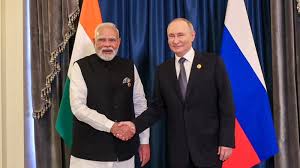
India and Russia have reaffirmed their historic friendship with a bold economic vision, as Prime Minister Narendra Modi and President Vladimir Putin set bilateral trade on course to surpass $100 billion well before 2030. This visit marks a new era of Indo-Russian cooperation, blending strategic trust with economic ambition.
Indo-Russian Trade Relations Enter a New Era of Friendship
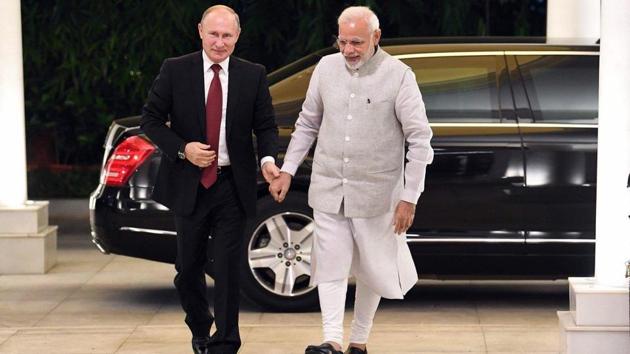
The 23rd India-Russia Annual Summit, held in New Delhi during President Vladimir Putin’s state visit, has redefined the contours of bilateral relations. What began as a partnership rooted in defense and strategic alignment has now evolved into a robust economic trajectory, with both nations pledging to deepen cooperation across energy, technology, pharmaceuticals, and connectivity projects.
Prime Minister Narendra Modi welcomed President Putin with warmth and symbolism, underscoring the “Special and Privileged Strategic Partnership” that has endured for 25 years. Against the backdrop of global sanctions on Russia and tariff pressures on India, the summit showcased resilience and mutual trust.
Key Economic Highlights
- Trade Target: India and Russia reiterated their commitment to achieving $100 billion in bilateral trade by 2030, with Modi asserting that the milestone could be reached earlier.
- Currency Settlements: Both nations agreed to expand trade in national currencies, reducing dependency on the U.S. dollar and insulating transactions from external shocks.
- Sectoral Expansion: Agreements were signed in energy, defense, pharmaceuticals, and technology, with emphasis on co-production and co-innovation.
- Connectivity Projects: Revitalization of transport corridors and discussions on a Free Trade Agreement with the Eurasian Economic Union were advanced.
Annual trade already stood at $68.7 billion in 2024–25, a sharp rise driven by energy imports and diversified exports. The summit’s outcomes signal a deliberate shift from a defense-heavy relationship to a balanced economic partnership.
Strategic Context
Putin’s visit comes at a time of geopolitical flux. Russia faces thousands of Western sanctions, while India navigates tariff challenges from the U.S.. Yet, the ceremonial welcome at Rashtrapati Bhavan and the private dinner hosted by Modi highlighted the personal chemistry between the two leaders, often described as the “Modi-Putin era of friendship”.
This friendship is not merely symbolic; it is strategic. India gains energy security and defense cooperation, while Russia secures a reliable partner in Asia amid strained ties with the West.
Dr. Satya Brahma, Founder of Network 7 Media Group and architect of the India Leadership Conclave, offered a powerful reflection on the summit:
“The Modi-Putin era is more than a diplomatic embrace; it is a declaration of economic sovereignty. By anchoring trade in trust and national currencies, India and Russia are scripting a new chapter in multipolarity—where friendship becomes a force multiplier for global stability.”
The Indo-Russian partnership, tested by time and turbulence, now stands at the threshold of transformation. With trade, trust, and technology as its pillars, the Modi-Putin era promises not just continuity but reinvention—an alliance that blends history with vision, and friendship with future.
The Modi–Putin friendship signals a strategic recalibration for the West, particularly the United States, as India deepens ties with Russia despite Donald Trump’s aggressive tariff regime. It underscores India’s pursuit of economic sovereignty and multipolar diplomacy, challenging Washington’s attempts to isolate Moscow.
Modi–Putin Friendship: Implications for the West
A Tightrope for India
Prime Minister Narendra Modi’s embrace of Russian President Vladimir Putin during the 23rd Annual Summit in New Delhi was more than ceremonial. It was a deliberate assertion of India’s independent foreign policy. Analysts describe it as a “tightrope walk” between historical ties with Russia and growing partnerships with the U.S..
Modi’s declaration that Indo-Russian friendship is a “Pole Star” — steadfast through crises — was widely interpreted as a subtle message to Washington. By anchoring trade in rupees and rubles, India and Russia are reducing exposure to U.S. sanctions and tariffs, effectively insulating their economies from Western pressure.
Trump’s Tariff Challenge
Donald Trump’s administration has imposed up to 50% tariffs on Indian exports, citing India’s continued purchase of Russian oil. He has also backed legislation enabling tariffs of up to 500% on countries trading with Russia, a move that could severely impact India’s economy.
These tariffs threaten sectors like textiles, leather, and marine exports, amounting to nearly $64 billion worth of goods. For India, the Modi–Putin friendship becomes a counterbalance: by diversifying trade with Russia, India reduces dependency on U.S. markets and asserts leverage in negotiations.
Strategic Signal to Washington
- Economic Sovereignty: India’s pivot to Russia demonstrates its refusal to let U.S. tariffs dictate its trade choices.
- Energy Security: Russian oil remains a lifeline for India, despite U.S. pressure to cut imports.
- Multipolarity: The friendship signals India’s commitment to a multipolar world order, resisting binary choices between Washington and Moscow.
Dr. Satya Brahma, Founder of Network 7 Media Group, contextualized the significance:
“The Modi–Putin friendship is India’s strategic insurance against tariff coercion. By deepening trade with Russia, India is telling the West that sovereignty cannot be taxed. This is not defiance—it is diplomacy with dignity”.
For the West, especially the United States, the Modi–Putin era is a reminder that India will not be a passive player in global geopolitics. Trump’s tariffs may squeeze Indian exports, but they also accelerate India’s resolve to diversify partnerships. The Indo-Russian bond thus emerges as both a shield and a signal: a shield against economic coercion, and a signal that multipolarity is the new reality.
Author
Related Posts
Satya Brahma’s Vision India
Photo Gallery