Iran’s unrest reflects a nation at a crossroads, with global repercussions that could reshape Middle East stability and world peace. The protests are driven by economic collapse, repression, and a yearning for freedom, while Donald Trump’s interventions have escalated tensions internationally. Nations divided between supporting Trump’s hardline stance and cautioning against military escalation highlight the fragile balance of global diplomacy.
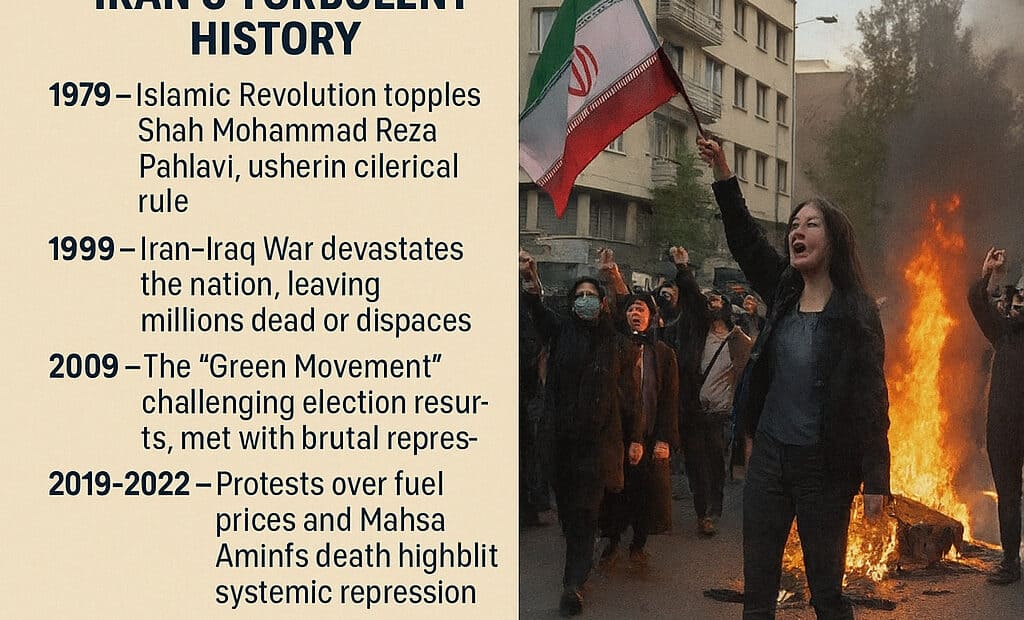
Timeline of Iran’s Turbulent History
- 1979 – The Islamic Revolution topples Shah Mohammad Reza Pahlavi, ushering in clerical rule.
- 1980–1988 – Iran-Iraq War devastates the nation, leaving millions dead or displaced.
- 1999 – Student protests erupt, crushed by security forces.
- 2009 – The “Green Movement” challenges election results, met with brutal repression.
- 2019–2022 – Protests over fuel prices and Mahsa Amini’s death highlight systemic repression.
- Dec 2025–Jan 2026 – Current unrest begins with inflation and currency collapse, spreading to 180 cities across all provinces. Women lead demonstrations, burning hijabs and reviving pre-1979 symbols.
The People’s Yearning for Change
Iranians across demographics—students, workers, women—are demanding economic dignity, political freedom, and an end to authoritarianism. The protests have claimed thousands of lives, with executions and mass arrests fueling anger. The revival of pre-revolutionary symbols signals a deep desire to break from clerical rule and reclaim national identity.
Implications for World Peace
- Grave Danger? Yes. Iran’s unrest risks destabilizing the Middle East, with spillover effects on oil markets, regional alliances, and nuclear tensions.
- Global Peace Impact: If Iran collapses into civil war or faces external intervention, the ripple effects could trigger refugee crises, proxy conflicts, and economic shocks worldwide.
Donald Trump’s Interventions
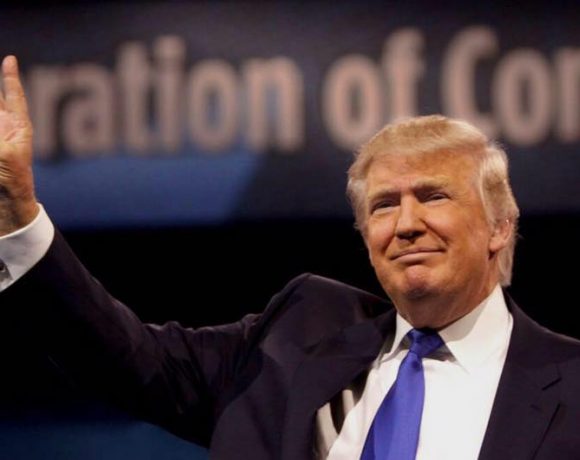
- Trump has warned Tehran of military action, referencing the 2025 bombing of nuclear facilities.
- He imposed a 25% tariff on nations trading with Iran, effectively weaponizing global trade.
- His strategy aims to force Iran into “strategic submission,” but risks escalating into war.
- Critics argue Trump’s interventions embolden hardliners in Tehran while alienating allies.
Nations Supporting Trump
- Supportive: Israel strongly backs Trump’s hardline stance, seeing Iran as an existential threat.
- Cautious Allies: Saudi Arabia, Qatar, Oman, and Egypt urged Trump to avoid military strikes, fearing regional fallout.
- Impacted Nations: China, India, Turkey, Russia, and the EU face tariffs if they continue trading with Iran.
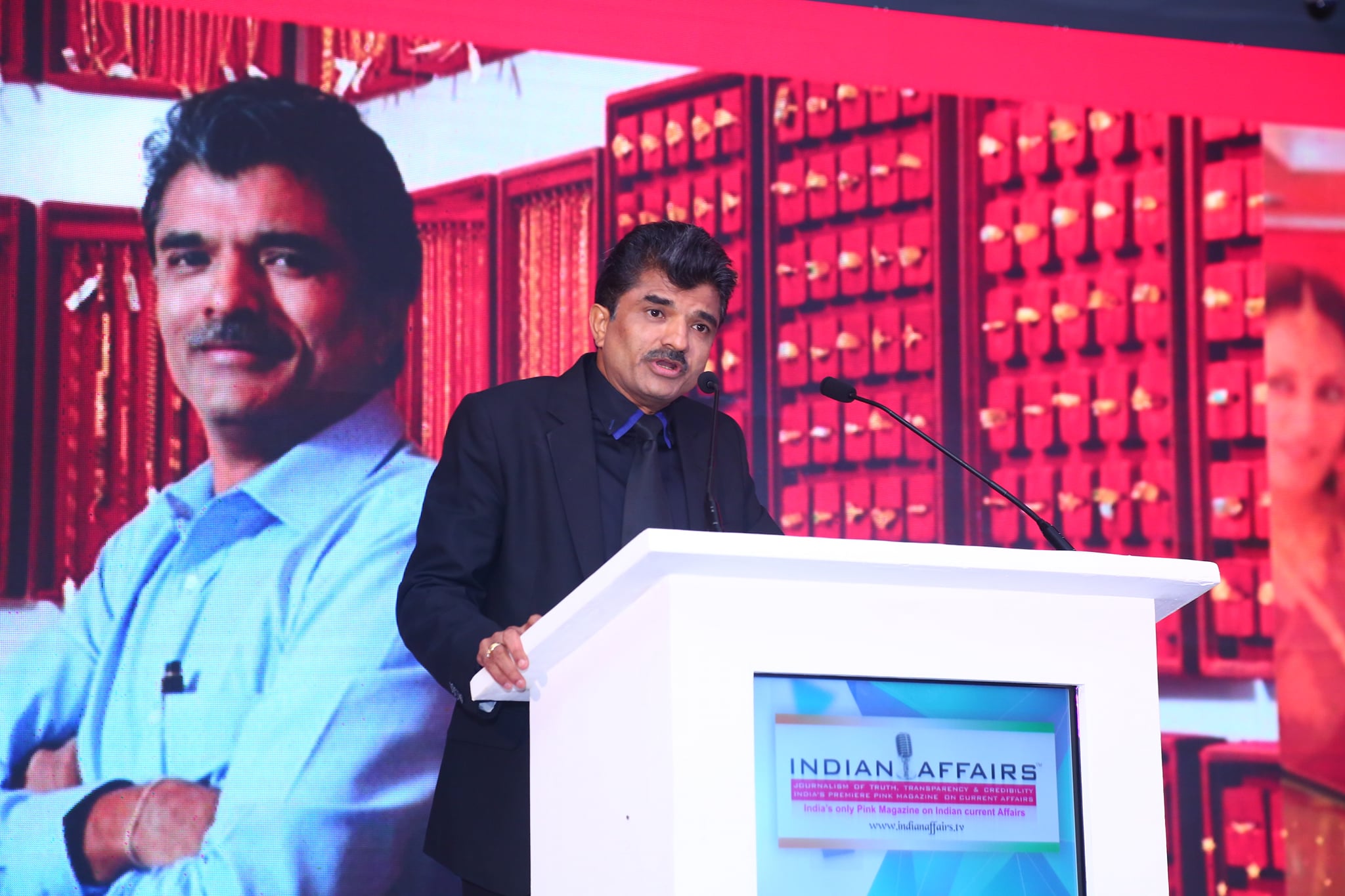
Dr. Satya Brahma, Founder & Editorial Head, Network 7 Media Group said
Iran’s unrest is not just a domestic upheaval—it is a mirror reflecting the fragility of global peace. The yearning of its people for freedom must be respected, but reckless interventions risk turning a cry for dignity into a conflagration that engulfs the world.Peace is not the absence of conflict—it is the presence of justice. Iran’s future must be shaped by its people, not imposed by foreign powers. The world must choose dialogue over domination, empathy over escalation. Only then can we claim to be architects of peace
Iran’s protests are a historic moment of defiance against decades of repression. The world faces a delicate choice: support the Iranian people’s aspirations without plunging the region into chaos. Trump’s interventions sharpen the stakes, dividing nations between confrontation and caution. The outcome will shape not only Iran’s future but the trajectory of global peace.
The Practical Solutions as envisaged by Dr Satya Brahma
“A Path to Peace: Resolving the Iran Crisis with Dignity and Global Wisdom”
“The Iran crisis is not a chessboard for superpowers—it is a human tragedy unfolding in real time. The solution must begin not with missiles or sanctions, but with empathy, diplomacy, and a recognition of the Iranian people’s right to self-determination.”
- Recognize the People’s Voice
- The global community must acknowledge the legitimacy of the Iranian people’s demands for freedom, dignity, and economic justice.
- Peaceful protest is not terrorism. It is the heartbeat of democracy.
- End Weaponized Sanctions
- Sanctions that cripple civilians—denying medicine, food, and basic services—must be restructured.
- Targeted sanctions on corrupt elites and military profiteers are justified; blanket economic warfare is not.
- Convene a Global Peace Summit
- A neutral platform—hosted by nations like Switzerland, India, or South Africa—should bring together Iranian civil society, diaspora voices, regional stakeholders, and global powers.
- The goal: a roadmap for democratic transition, economic recovery, and human rights guarantees.
- De-escalate Military Posturing
- The United States, under President Donald Trump, must shift from threats to dialogue.
- Military strikes and tariff ultimatums only deepen the crisis and embolden hardliners.
- Empower Regional Diplomacy
- Nations like Oman, Qatar, and Turkey can mediate with cultural proximity and strategic neutrality.
- A regional peace framework—modeled after the Helsinki Accords—can stabilize the Middle East beyond Iran.
- Amplify Independent Media and Civil Society
- The world must support Iranian journalists, artists, and activists who risk their lives to tell the truth.
- Information is liberation. Censorship is tyranny.
Author
Satya Brahma’s Vision India
Photo Gallery