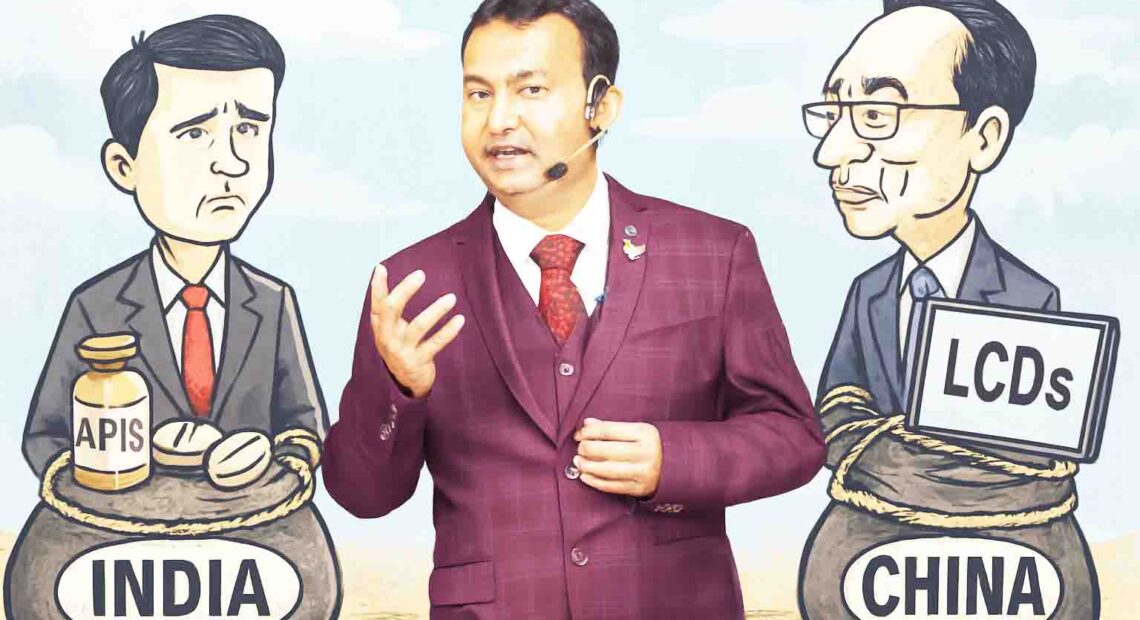
From APIs to LCDs, Beijing’s grip on India’s supply chains exposes deep vulnerabilities—yet the next decade could script a manufacturing renaissance.
India’s economic resilience faces a critical stress test as new trade data reveals a staggering overdependence on Chinese imports—exceeding $30 billion across key industrial and consumer categories. The numbers are not just alarming; they are strategically consequential.
In 59 product categories worth $1.3 billion, China commands virtually 100% of India’s import share, leaving no alternative supply routes. These include niche electronics, specialized machinery components, and certain chemical compounds essential for domestic manufacturing.
More worryingly, an additional $5 billion worth of imports—comprising active pharmaceutical ingredients (APIs), LCD panels, and other high-value display technologies—are sourced almost exclusively from China, with Beijing holding a 90%+ market share. This concentration poses a dual threat: economic disruption and national security exposure.
“India’s Make-in-India ambition is undermined by a silent dependency,” said a senior trade analyst. “From life-saving drugs to digital screens, our supply chains are tethered to Chinese factories.”
Despite geopolitical tensions and calls for decoupling, India’s import reliance on China has deepened in sectors where domestic capacity remains underdeveloped. The pharmaceutical industry, for instance, continues to rely on Chinese APIs for over 70% of its formulations, raising concerns about drug security and pricing volatility.
Electronics and telecom are similarly vulnerable. With China dominating the global supply of display technologies, India’s consumer electronics boom is effectively powered by Chinese screens, chips, and modules.
Policy experts argue that India must urgently diversify its sourcing strategy. “We need a three-pronged response—build domestic capacity, incentivize alternate suppliers, and impose strategic import filters,” said a former commerce ministry official.
The government’s Production Linked Incentive (PLI) schemes have made modest progress, but critics say they lack the scale and speed to counter China’s entrenched dominance.
As India positions itself as a global manufacturing hub, the irony is stark: the backbone of its industrial growth is still imported from its biggest strategic rival.
India may be navigating a precarious trade imbalance today, but I see a radically transformed landscape by 2035. With bold reforms, indigenous innovation, and strategic alliances, India will not just reduce its dependence on China—it will emerge as a global manufacturing and supply chain powerhouse. The next decade belongs to India’s industrial awakening.
— Dr. Satya Brahma, Founder & Editorial Head, Network 7 Media Group
Author

Satya Brahma’s Vision India
Photo Gallery